

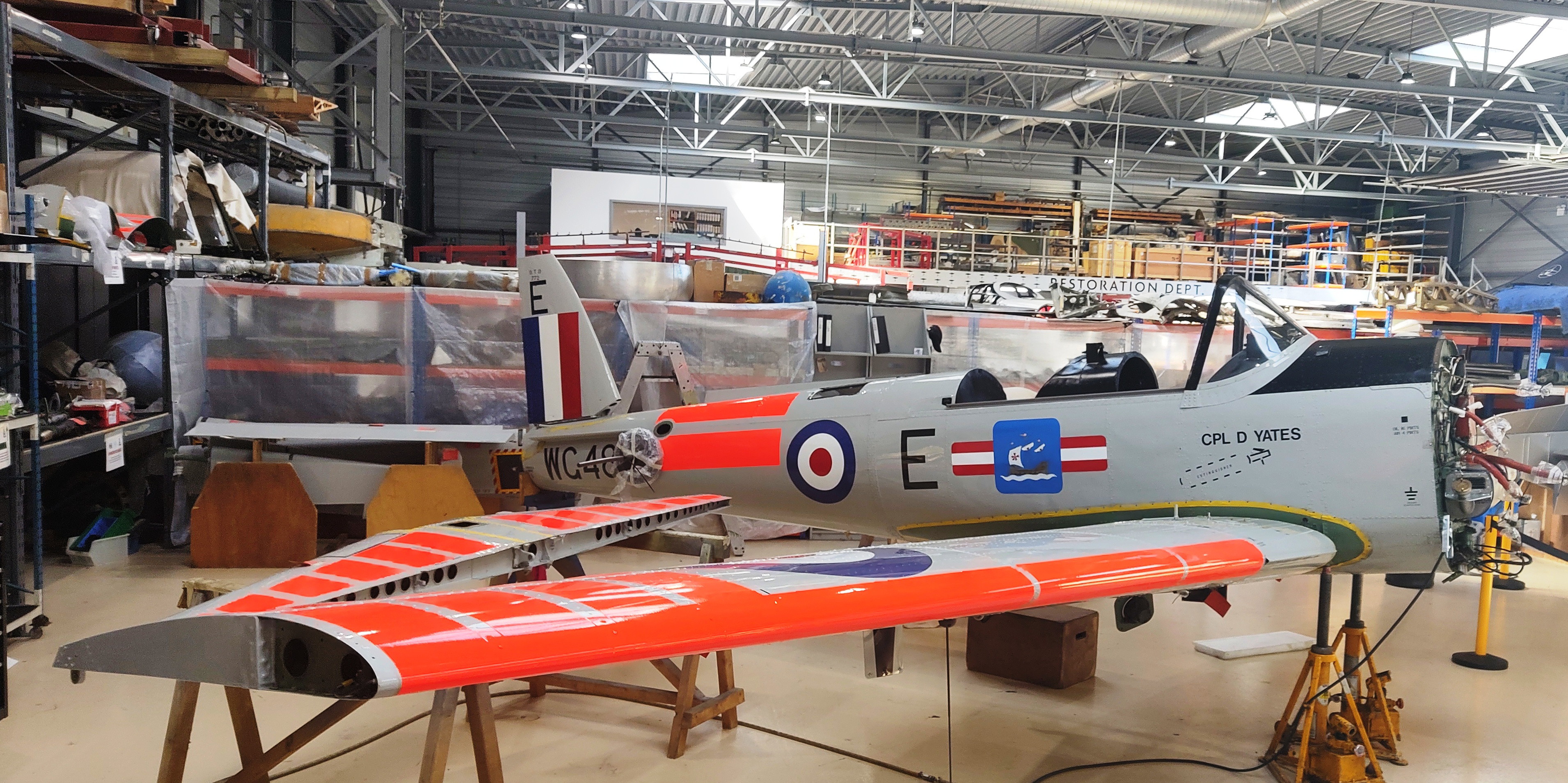
BBMF Chipmunk T10 WG486 is currently undergoing ‘Major’ maintenance with the Aircraft Restoration Company (ARCo) at Duxford.
WG486 was flown to Duxford at the end of May, and work on the ‘Chippie’ started in earnest on 4th June. The aircraft was weighed; the propeller was removed and the Gypsy Major engine was inhibited and removed for overhaul. The flaps, ailerons, rudder and elevator have been removed, and the aircraft has been stripped for inspections to take place. Various components requiring ‘bay maintenance’ have also been removed. Non-destructive testing (NDT) has been carried out, 56 Structurally Significant items (SSI) inspections have been completed, and zonal surveys and inspections are underway.
The Chipmunk will not be repainted during the Major but will retain its current markings, which are those it wore while serving with Bristol Univeristy Air Squadron at Filton in 1972. This decision was made because the surface finish is in excellent overall condition and the use of Ceconite synthetic fabric (rather than Irish Linen) to cover the wings and control surfaces means that the fabric is also in fine condition and does not need to be replaced. A completion date for the maintenance on WG486 has not been set as ARCo is prioritising work on the BBMF Lancaster, but output is likely to be in early 2027.
Chipmunk T10 WG486 was originally built at the De Havilland factory at Broughton, on Hawarden Airfield, near Chester, the same facility where BBMF Lancaster PA474 was manufactured. It was delivered to the RAF in January 1952. WG486 has spent most of its 74-year service life as a trainer, but unusually for a training aircraft it has twice been involved in frontline operations. In December 1958, WG486 was issued to 114 Squadron in Cyprus, where it was used in operations against the EOKA terrorists, flying low-level reconnaissance patrols and convoy escort missions, with British Army officers in the rear seat. After 27 years back on training duties in the UK, WG486 was moved to Germany in 1987 to operate as part of the Gatow Station Flight in Berlin, which was then surrounded by Soviet Communist Block territory, where it embarked on a second phase of operational flying. For the next two years the Chipmunk was flown on what were then highly secret Cold War covert photographic reconnaissance ‘spy’ flights in and around Berlin. WG486 joined the BBMF in 1995.


