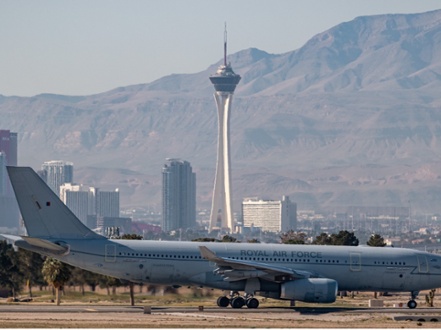
On 2 February 2026, an RAF crew from 32 (The Royal) Squadron flew their Envoy IV CC1 aircraft from RAF Northolt to Bardufoss Air Station in Norway, conducting a High North training sortie designed to sharpen essential skills in one of the world’s most demanding operating environments.
Operating in the High North is a core requirement for RAF aircrew. Extreme cold, limited daylight and rapidly shifting weather create conditions that are not easily replicated in the UK. Training sorties into northern Norway allow crews to practise cold‑weather procedures, operate from icy airfields and understand the practical challenges of flying in Arctic terrain. As a long-standing NATO ally, Norway provides ideal facilities at Bardufoss, ensuring visiting crews can build their skills alongside partner forces.
For 32 (TR) Squadron, the sortie also demonstrates the adaptability required in their Command Support Air Transport (CSAT) role. CSAT enables the rapid global movement of personnel, as well as critical freight, ensuring the UK can respond at pace to operational requirements wherever they arise.

High North: Increasingly Central to UK Defence
With the UK preparing to deploy a new Carrier Strike Group to the High North later this year, cold‑weather readiness is high on the agenda across Defence. The region’s strategic importance continues to grow, and the Armed Forces are actively rebuilding the cold‑weather experience required to operate confidently above the Arctic Circle.
This focus extends beyond the High North itself. In the South Atlantic, the British Forces South Atlantic Islands regularly contend with severe, unpredictable weather. Mount Pleasant Airfield on East Falkland is exposed to dramatic winds, freezing temperatures and rapid weather shifts - conditions that make the operational management of the RAF’s airfield in the region critical.
Exercises such as Joint Viking allow UK personnel to train for these challenges in a controlled but demanding environment. During Joint Viking 2025, around 10,000 troops from seven nations-including Norway, Canada, Finland, Germany, the Netherlands, the UK and the USA - conducted complex scenarios in the Norwegian Arctic. The RAF Regiment’s Combat Readiness Force (CRF) used the opportunity to test its skills at the tactical level while supporting operational‑level planning alongside NATO partners.
Large-scale exercises such as Cold Response 2026 are set to continue this momentum, integrating land, sea and air forces across the High North to test interoperability and ensure NATO remains ready to operate in real Arctic conditions.
Whole Force Cold‑Weather Activity
Cold‑weather training is now taking place across a broad range of RAF platforms:
Chinook (HC6A)
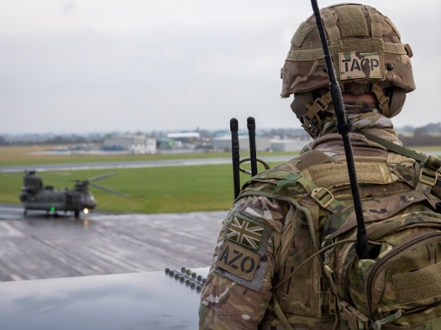
In early 2026, Joint Helicopter Command deployed Chinook crews 200 nautical miles inside the Arctic Circle to Bardufoss Air Station. Crews are practising mountain flying and underslung load operations in temperatures down to –20°C - vital skills for supporting austere operations and humanitarian tasks in remote areas.
Typhoon (FGR4)
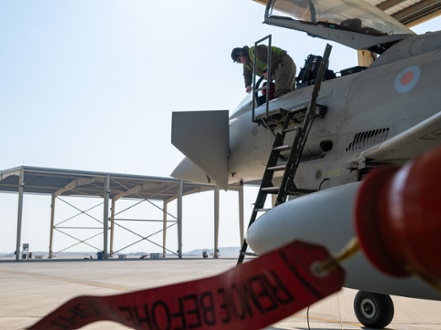
Throughout late 2025 and early 2026, Typhoons from IX (Bomber) Squadron took part in Ex Arctic Phoenix and Ex Tarassis. These sorties tested Agile Combat Employment (ACE) concepts, including dispersed operations from remote Norwegian airstrips and cross-servicing alongside Norwegian F‑35As.
F‑35B Lightning
Set to deploy with the Carrier Strike Group later this year, the F‑35B will continue to strengthen the UK’s contribution to air power in the High North. The aircraft routinely works with allied F‑35 operators who fly in austere Arctic conditions year‑round, building shared understanding of fifth‑generation operations in demanding environments. UK Lightnings have previously operated from Iceland as part of broader NATO activity and, importantly, have conducted several High North sorties from HMS Queen Elizabeth and HMS Prince of Wales into the Norwegian Sea and regions above the Arctic Circle. These deployments provide valuable experience of northern airspace, maritime integration and operating at range alongside partner nations.
Atlas A400M
In October 2025, an A400M completed a historic first landing on Jan Mayen, a remote Arctic island with no paved runway. The aircraft has also supported trials of forward air refuelling points in Arctic conditions - an important enabler for dispersed operations.
Poseidon MRA1
Operating from RAF Lossiemouth, the Poseidon fleet provides essential maritime patrol, anti‑submarine warfare and sensor support during large NATO exercises, including Cold Response and Arctic Phoenix.
Agile Combat Employment: Increasing Flexibility and Survivability
Agile Combat Employment (ACE) is about practising how to keep aircraft flying if a main base can’t be used. Instead of relying on one large airfield, crews train to move quickly to smaller, harsher locations and operate with only what they need, often working alongside NATO partners who do the same. Recent training - like Typhoons flying from remote, snow‑covered strips in Norway and an A400M landing on Jan Mayen with no proper runway - is helping the RAF build experience, learn what works in tough conditions, and improve how we keep aircraft moving when the environment makes things harder.
Maintaining a Ready Force
Training in the High North reinforces a simple principle: RAF aircraft and personnel must be ready to operate anywhere, in any conditions. Whether supporting UK interests in the Arctic, sustaining operations in the South Atlantic or delivering command support tasks worldwide, the RAF continues to build the experience needed to operate effectively in cold-weather environments.
From 32 (The Royal) Squadron’s Envoy IV to Typhoon, Chinook, F‑35B, A400M and Poseidon, the RAF is strengthening its capability across the force - ensuring aircraft can be deployed anytime, anywhere, in any climate.