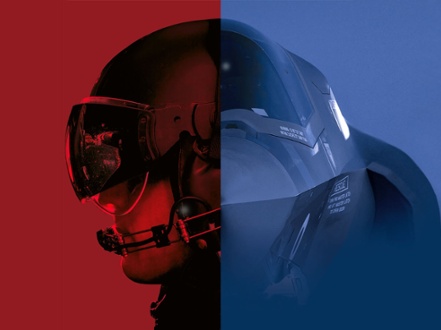
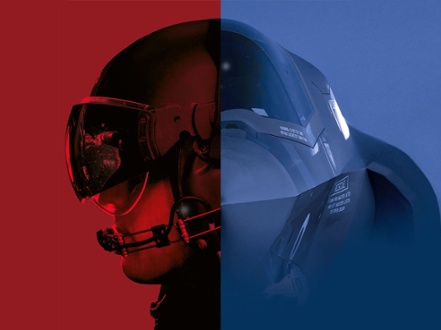
Ever wondered what it takes to put on one of the most spectacular displays in the sky?
Come behind the scenes with the RAF Typhoon Display Team.
Listen on your favourite podcast app or on our dedicated podcast page.
Inside Air Transcript 153.
Please note that this transcript is automatically generated, and may have some errors. The original audio is the authoritative wording.
Intro Jingle: Standby for broadcast. Standby for broadcast.
Narrator: You're listening to Inside Air, a behind the wire view of the Royal Air Force, its people, technology and operations.
Flight Lieutenant Chris Sully: Hi, I'm Flight Lieutenant Chris Sully, and welcome to the latest RAF Inside Air podcast. Ever wondered what it takes to put on one of the most spectacular displays in the skies? This time we're going behind the scenes with the RAF Typhoon Display Team to discover the skill, precision, and intense preparation that goes into getting ready for the display season.
Flight Lieutenant Aidan Rae: Yeah, so it starts all the way back in November of the year before. If we're talking about the 2027 season, that will start in November this year. We'll look at that calendar, start planning out what displays we can do. Although, members of the public, you'll see that we don't publish our calendar till March.
So there's a lot of time between us first looking at the calendar in November and you seeing it in March.
Sergeant Polly: It's been quite good this year from an engineering perspective, but we do get different issues each year, and that's for me to analyze and collect that data and then feed it back in. But yeah, engineering's definitely the fun side of it.
Flight Lieutenant Tom Nation: The standard of people that we get coming through the Typhoon Force is that anyone could do it if they were given the right training. You couldn't just jump out of your frontline role and go and fly a display, but if you had the same workup that I've had, any of the, the pilots on the frontline or on 29 Squadron could fly a display.
But it takes a good sort of six months to get to that point where you're ready to do it.
Flight Lieutenant Chris Sully: As usual, we'll also reheat a few stories which could have slipped under your radar, but there's no Ben this time, or under the hat. He'll be back next time round. The roar of the engines, the breathtaking maneuvers, and the sheer power of the RAF Typhoon.
What does it really take to make those spectacular displays happen? With the 2026 season over, preparations are already well underway for next year. From the engineers keeping the aircraft in peak condition, to the planners working behind the scenes, and the pilot putting it all on the line in the cockpit, there's a lot more to the display than meets the eye.
AS1 Chris Keen has been given a behind-the-scenes look at RAF Coningsby, revealing the people, precision, and preparation that make the magic happen.
AS1 Chris Keen: The unmistakable sound of the Eurofighter Typhoon. You can hear it and feel it before you can see it. And I've been lucky enough to spend the last five months here at RAF Coningsby with the Typhoon Display Team as their digital media manager, and what a display season it has been.
The Typhoon has displayed at 27 venues, completed 34 displays, along with seven flypasts. There have been around 2.8 million people who have come out to see the display at air shows, and on our social media we've had 26 million views of our content. It's been pretty special. Now, as the season is finished, we wanted to do a recap of what the season's been like with the team.
So I'll be talking to the main man himself, Flight Lieutenant Tom Nation, AKA Dragon 01, this year's display pilot. I'll also catch up with the engineering manager, Sergeant Polly Grimmer, who is a bit of a legend in the display world. Let's start though with Flight Lieutenant Aidan Rae, who is the display team manager.
He'll tell us all about the effort that goes into a display season. But first, let's find out what his role entails.
Flight Lieutenant Aidan Rae: Chaos, utter chaos is the short answer. So we're a really small team, so I've got myself and my eng manager. That is it for kind of us getting the team out the door. So a lot of what my role does is organizing air fields and air shows, is the best way to put it.
So my primary kind of function during the season Is liaising with all the display directors at all the shows and display sites that we plan to go out to, and making sure that all of our rules and regulations are adhered to, that all of their paperwork's in hand. It's a lot of spreadsheets and admin.
Outside the season, it's a lot of planning for the next season. So one of my main roles as we come out of one season and start planning for the next, is we'll get the calendar of all the displays that have applied for us for the next season, and I will go through that entire calendar of what they want versus what we want, and look at all these display sites, work out if they're doable.
Believe it or not, Typhoon's quite loud, so we can't just display wherever and anywhere we want. Those Rolls-Royce engines at the back are pretty loud. So yeah, a lot of it is doing that, and then starting to spin up how we deploy out to those sites, who we deploy, where we deploy to. Quite a, a full-on job.
You don't get a lot of downtime.
AS1 Chris Keen: And you mentioned the team there. Lots of people outside looking in see the jet in the sky and the PR people on the ground, but there is a lot more that goes into it, isn't there?
Flight Lieutenant Aidan Rae: Yeah, absolutely. So although myself and the eng manager are the only two permanent positions on the team, we have a lot of volunteers.
The team ends up about 90 strong, almost all volunteers apart from us, and the pilot obviously. So every weekend that you see us display anywhere, obviously you've got the pilot in the jet throwing it round and doing some loop-de-loops, looking fancy. You'll have our PR team on the ground, like you've already mentioned, but they are volunteers from across RAF Coningsby, a mix of professions and ranks, so that anyone that comes and chats to our PR team isn't just getting engineers.
It's not just getting myself as an operations officer. It's getting a bit of everything and anyone. You've then also got the engineers. So we have three engineering teams all named after previous display airframes. Team Gina, Team Blackjack, and Team Moggy. They're all made up of volunteers from 29 Squadron.
We take five engineers and an engineering officer, and then some ground support staff as well. So it is very much a team effort to get Tom the Shear in the sky.
AS1 Chris Keen: And you mentioned earlier that people have to apply to get the Typhoon at their display. Talk us through that process.
Flight Lieutenant Aidan Rae: Yeah. So if any display sites want to apply to have us, it's exactly the same as the Red Arrows, BBMF, the Falcons, Tutor.
On our RAF website page, you'll see Apply For the Typhoon Display Team. It's a short application that goes into the air events team. They will filter out all the stuff we're not allowed to do. So we're not allowed to do things like weddings, birthday parties, Miss Miggins down the road just wants a display over her garden.
But what we can do is a lo- all of these recognized shows, all of those kind of big shows will go into one big pot, and air events discuss with us what the priorities are, and then we come out with a kind of calendar that fits. Not every show can be successful in those bids, unfortunately. We would absolutely love to do every single display we possibly can.
We're limited to between 35 and 40 displays a year. So for example, this year we did 34 successful displays. We planned 36 and achieved 34.
AS1 Chris Keen: So you've already answered the question, but me renewing my vows next year, that's a no?
Flight Lieutenant Aidan Rae: Unfortunately, yeah. That's a no.
AS1 Chris Keen: So I'm sure it's not an easy task, but what goes into planning a whole season for the Typhoon Display?
Flight Lieutenant Aidan Rae: Yeah, so it starts all the way back in November of the year before. If we're talking about the 2027 season, that will start in November this year. We'll look at that calendar, start planning out what displays we can do. Although, members of the public, you'll see that we don't publish our calendar till March.
So there's a lot of time between us first looking at the calendar in November and you seeing it in March. It's a lot of backwards and forwards to work out that calendar, depending on Air Force priorities, where we can display, what overseas we're gonna do that year, where all the shows are. There's a lot of balancing between us, the Red Arrows, and BBMF as well.
So some shows you'll see that you'll get one of us but not the other, just to try and spread the resource afar and get as many people to see something as possible. We then start planning all of our engineering teams. So our volunteers will be picked in kind of January, February time. So a lot of that is then allocating PR and engineering teams to all the various shows and working out, making sure we've got cover for all of them.
One of the big ones is the overseas displays. We start planning them in probably February, March time, depending on where they are, because all of our kit and equipment moves by road. We don't fly it in, so we need to start planning how long it's gonna take them to get there, what time they need to leave, how far in advance they need to leave.
So going back to kind of our Turkey example from last year, the kit left almost two weeks before. So it's not just a, we fly out a couple of days before and everything's there. We take everything with us. Usually it's one or two lorries that transport all our kit across. So yeah, before the season, it's all getting everything into place so that as soon as we hit kind of the end of May and we hit our first display, most of the season is planned, sorted, in position, and it's a lot of just all the finishing touches and paperwork catching up.
AS1 Chris Keen: And if we break it down into each individual display, I've seen you in the build up to a display with your head down in your computer. I've heard the word diversion so many times. What goes into the actual display itself and the planning?
Flight Lieutenant Aidan Rae: There are three parts to it. Tom's part, my part, and the engineering manager Polly's part.
For Tom, he will plan all the routes to and from. He will go into our mission planning system, we call it Tyampa, and he will plan route A to route B. English Riviera is a great example from the first one of the season. We flew past Brize Norton on the way past, on the way down, landed at Exeter for English Riviera, and he will go via the show site for a bit of a recce on the way in.
He will plot all of that onto the mission planning system. It loads onto a little black brick, basically like a portable hard drive, and loads into the aircraft that way. What he'll feed to me is a lot of his fuel levels. So we need to book what's called diversions, and basically we'll talk to an airfield and go, "If something happens at our destination, we would like to come to you instead, and we'd like to hold you as that emergency option."
The reason we do that is display is very fuel intensive because we're stuck to a single fuel tank on the bottom. So our diversions have to be picked very carefully so that we've got the fuel to get to them should anything go wrong at our primary airfield. And Tom will work all that fuel numbers out in advance to make sure they're suitable.
So a lot of that's talking to random airfields you've never heard of before, a lot of the time to try and get something. And then my job in kind of the week run up is to make sure the paperwork's in place. So believe it or not, display flying is very heavily regulated because it's such a dangerous activity.
We do it because it, it's a great thing to do, but comes with some inherent risks. So all of those regulations protect us, protect the public, make sure our display is safe above anything else. My job is to make sure all of that paperwork is in place long before we even get to the show site. So that when Tom's planning the l- couple of days before and looking at maps, he's looking at restricted airspace, he's looking at display timings, he's got all of that information to hand.
And then Polly's side of the house, she will make sure all the engineering teams are prepped. They've got all their kit. The kit goes out the door at the right time. The airport's actually suitable for us to operate from. They o- they refuel with the right fuel for the aircraft. The guards have somewhere to operate from because we always have to have UK eyes on our aircraft.
So she'll make sure all of that bit's in place. So Polly will do the airport, I'll do the air show, and Tom does that bit in the middle, the bit in the box, if you will.
AS1 Chris Keen: Amazing. There is so much that goes into it, and I've really seen that from my side this year. So let's talk about the 2026 season then.
From my point of view, it's been amazing. How has it gone?
Flight Lieutenant Aidan Rae: It's been an absolutely incredible season. Obviously, the kind of big one on everyone's minds, we unfortunately lost RIAT this year, which is an absolute highlight of our calendar. But we bounced back and picked up some extra displays as well. So including RIAT, we started this season planning 33 displays.
We ended up with 34 successful ones and 36 planned. Unfortunately, we lost a couple just for those random little reasons. But it's still an absolutely incredibly successful season. To only lose two in an entire season is a testament to Paulie and the engineering side of house's work. We had our PR team at another extra four events on top of that, so meeting members of the public.
We were looking at the stats yesterday, and across all the air shows we displayed at, 2.8 million of you came out and saw us display across the country, Denmark, and Sweden this year. And then Chris, all of your work, 26 million people have seen our social media content this season, which for us, our biggest aim, yes, we love to throw the aircraft around and do loop-the-loops, but it's all about engagement.
It's all about, showing the members of the public what we do and what we're about. So 26 million people seeing all of that on social media is absolutely incredible.
AS1 Chris Keen: Awesome. I will pay you later on for that. Thank you very much. Now, you sum it up really good whenever we have visitors come in because those millions of people that have seen the display this season, they're in awe of it, aren't they?
And it's just incredible to see, and we forget because we see it all the time how good that is for them, don't we?
Flight Lieutenant Aidan Rae: Yeah, and I think that is a lot of the magic of my job, and PR especially. We walk through the hangar all the time. We see 15 big gray aircraft, and we don't bat an eyelid. They're there all the time.
It just exists. We've been recording this podcast, and they're taking off, and we keep having to stop it and start. And we don't bat an eyelid. It's just routine business. And then you host a visit like, so for example, some of our corporate sponsors, and people are genuinely in awe of it. And, families on the squadron, they'll bring their kids to see, this is what I do, and the kids absolutely love it, and the excitement on everyone's faces.
And then you get out to the shows, and kids trying on the helmets and the jackets and just absolutely loving it. And it just restores that magic and actually what we do is a pretty cool job to do. But how much, the aircraft, people come out in their droves to see it. People follow our content and get really excited about it.
Yeah, very much restores your magic in the Air Force and the big gray jet that just gets a bit noisy sometimes.
AS1 Chris Keen: Yeah. It is great to see. And you have it for another year, so you're in the role next year as well.
Flight Lieutenant Aidan Rae: Yeah. So I'm incredibly lucky. So I get to do this job for two years. It's the same as the engineering manager role.
So we flip-flop. So I took over last year in November from my predecessor. The new engineering manager is doing their handover at the moment, and then I'll change over, unfortunately, at the end of next season.
AS1 Chris Keen: Brilliant. So let's finish then by, and I'm not sure if you're gonna be able to nail this one down to just one moment, but has there been any particular highlights for you this season?
Flight Lieutenant Aidan Rae: I knew you were gonna ask this question. It's such a difficult one. There's been so many this season. My first one is seeing the jets off for the first time. So English Riviera was our first display this year. You've worked so hard to get to that first weekend. There is so much work put in, and then you walk out to the flight line, you see the two jets depart for the first time and go, "That's it.
We've got to this point. We're going." Sweden's got to be up there as well. So I was very lucky to go out and join the team when we went out to Sweden for their centenary air show. Again, that was an incredible experience. And then Ayr. So I, believe it or not, if you can't tell from my accent, I come from north of the border. So Ayr is our kind of one Scottish show that was on the calendar this year, so I obviously made sure to go to my home show. And my parents came out to see it and see all the work that we've put in. And just seeing, again, how proud my parents are of kind of everything is again, got to be up there.
AS1 Chris Keen: So I'm now just walking through 29 Squadron hangar, and to the left of me and the right of me, all around me, basically, there are Typhoons.
And even though I have been here for five months and have seen these jets up close on a daily basis, it will just never get old. Typhoons are just amazing. So I'm heading over to speak with the engineering manager, Polly, to find out what her role consists of.
Sergeant Polly: My role consists of eng selection for the engineering teams to making sure that the rotation of the three Typhoons that we've got are fit for the display season, from collecting and analyzing data to ensure that the display won't cause any issues later on down the line.
I also have the fun job of merchandise sponsorship. So I get to plan those corporate visits, get to design all of the merchandise for the year And I get to manage all of the people, so it's really nice. I get to hear how much fun they've had at the weekend so that you know that all of the hard work that I've done has paid off.
AS1 Chris Keen: I love that it's such a mixed bag. So unlike the pilot who only gets to do one year, and most of the team as well who only do a short period and they pass through, you've actually been here for quite a while, haven't you?
Sergeant Polly: So yes I'm super lucky. I've managed to do four display seasons as the engineering manager, and previous to that I was an eng team leader, and previous to that I was the supervisor, and previous to that I was the operator.
So I've been super, super lucky and clung on for dear life since 2015. But the reason why we do longer as the engineering manager and do it full time is because of having those relationships with sponsors, having those relationships throughout the RAF, and that corporate knowledge, just understanding the different airfields to what the team needs.
If we swap every year, information just generally gets lost. So for many years my role has been at least two years just to keep that continuity, and also it means that me and the manager can swap over alternatively and information doesn't get lost.
AS1 Chris Keen: Have you enjoyed it?
Sergeant Polly: Yes, this has been the best job ever.
Being the engineering manager, I just get to work with so many different people across different professions within the RAF, get to go to really cool locations. I've been lucky enough to go to Canada, Bahrain, Turkey Loads of different other places across Europe, big air shows across the UK. So it's a really fun thing that you get to do.
It's like the shiny side of the RAF. It is stressful at times 'cause obviously the workload gets very busy during the summer, but when the juniors come back and they've had the best weekend ever, it's really worth it.
AS1 Chris Keen: So talk us through the process then of what it takes to get the jet off the ground to go to a display.
Sergeant Polly: I wish I could take credit for getting the, the jets off the ground. That's my fantastic engineering teams that do that or the squadron. But yeah, the process starts January really, where the pilot has designed their display for the year and they go down to the simulator to start practicing it. So I get to go down and watch what they're doing and sometimes there's bits where I'm like, "Oh, that's very close to the limit.
Is there any way we can like pull that back a little bit?" 'Cause my concern is it's all well and good in the simulator, but once you take into the factors like the British weather, the last thing we want to do is accidentally push the aircraft past its limits because then it causes my engineering teams lots of work on the ground.
What may mean that we need to speak to industry, what means that we can't then fly the Typhoon. So I ask them very politely to tailor back certain maneuvers within the display just so that prevents too much work for the engineers at the weekend. Obviously, the engineers are there to work, however, we wanna make it as easy as possible for them.
Once we've done that, then we go into doing full practice displays. So as soon as they come back over Coningsby, I go out pretty much every time the pilot's displaying over Coningsby, watching, collecting data, any issues they've had with the jets, any like little twinges, what one of the jets might be doing, what the others aren't, and I monitor all of that.
And then by May all of this information is gathered. We get authority to do the display because we have issues sometimes with the way that they throw the jet around, the fuel moves around quite quickly, the flying control systems. So sometimes there's like little tweaks, but all this data that I gather is analyzed and then we should have three Typhoons that are good for display.
And then at that point it's down to the engineering teams really. I make sure that they have two jets in the right roll man. Generally a center line fuel tank fitted for UK, but sometimes we have to put 'em On the wings as well to go overseas. And then, yeah, once we're in display season, the engineering teams, they do their thing and the display happens.
And a lot of the time it's quite smooth, I say. I've said that now. But yeah, it's been quite good this year from an engineering perspective. But we do get different issues each year, and that's for me to analyze and collect that data and then feed it back in. But yeah, engineering's definitely the fun side of it.
AS1 Chris Keen: So as you say, it is down to the teams which you oversee. Tell us about those teams.
Sergeant Polly: So there's lots of teams involved. I have three engineering teams. So my engineering team's names got changed after our 20th display season. So we changed them to the names of previous paint schemes, the names that the public gave them.
So I have Team Gina, Team Moggy, and Team Blackjack Those teams consist of five individuals that are picked from 29 Squadron. Between them I have to have at least a sergeant, and then between that mix there has to be an avionics and a mech supervisor and operator of each trade. So that's four of them, and then we have an armorer.
And then when we go overseas, I have to take additional engineers with me. So as I previously said, sometimes we have to put extra tanks on. So overseas we take a tank team, so that's an additional two armorers go to remove those tanks, 'cause we're only allowed to display with a center line fitted. So with that we also take a squipper.
So that's our survival equipment. That's just the RAF nickname for them, and they're there just to check over the pilot's kit after each display. And that's the engineering teams.
AS1 Chris Keen: And it is quite an honor, isn't it, being part of the display team? I've loved every second of it. So in terms of the engineering teams, how do you select who gets to be on them?
Sergeant Polly: So the selection process actually starts pretty much after the season ends. So normally around November time we advertise. So for the engineering teams, they can purely come from 29 Squadron. That goes out in the squadron and via other media devices. And people can put their name down. They put which authorizations they have to working on Typhoon, if they've been on the team before, how long they've been on Typhoon.
And then come January, we have a large management meeting run by myself, and we go down and select the teams. So we start with the sergeants, then to the corporal to make sure that we've got a mech and an AV. And then we fill the, the free junior slots with an operator from being a mech, an AV, and a armorer.
And then that's the team. And then we'll, once I've got the names and I know which team's who, I will then go back and sit and work out which displays they can do to make it fair. So we try and give each team one of the big displays, and then some of the ones that are, like, based away from Coningsby, and then the ones that are based from Coningsby to make it even between the teams, rather than just going one, two, three, one, two, three, one, two, three, where the likelihood is one of the teams would get all of the overseas and the other teams would just get all of the Coningsby ones, what wouldn't be fair.
So it does take a little bit of planning to try and work it out. And for 15 slots last year, we had 54 people volunteer. So again, it was very hard to narrow it down to those 15 engineers, and then we have six on reserve. So there's 21 people that have the opportunity to go away. However, with 54, there's a lot of disappointed people on the squadron, but we encourage them to put their names down for PR or aircraft guard so they at least get to go away with a team and start to understand how we work, and then we always encourage them to put their names down the following year, and hopefully their experience levels are a bit higher and they get selected for Eng.
AS1 Chris Keen: Brilliant. So the big one then, which I've asked Tom and Aidan, I asked them what their highlights were for this season, but let's slightly change it for you because you've been around a lot longer, 10 years. So what highlights have you had over that time?
Sergeant Polly: Oh, that's a really difficult question Oh, there's just been so many highlights over the time.
Being part of the team that went to Canada, so the first time the Typhoon display team had been to North America was so much fun. The Canadians were lovely, and really strangely, so normally when we go away, the jets are there straight away. But we actually had a day before the jets arrived, so we got to actually go round and see a little bit of Canada, what was nice, what we don't normally get to do.
Another cool place that I've been was Turkey. Again, we had a bit of downtime in the middle, so we got to go and watch all of the hot air balloons take off at Cappadocia. So that was a really fun thing to do with the team, something nice. Air shows, RIAT is fantastic. So many of our corporate sponsors are there, and we just get hosted so well, and you get to see the other side of the RAF that you don't normally get to see when you're on the flight line.
So that's a true highlight. I think just the people as well. So from being on the engineering team, the camaraderie that you build with those other four individuals is fantastic. You have little in-jokes and, 'cause you just go away with them constantly for five months. It's just fantastic. So I do miss that.
But then we kinda have our own type of that in the office, so that's really good fun. Another highlight was I've been lucky enough to work on most of the paint schemes, but I was the engineering manager for Moggy, so Moggy does always have a place in my heart. Having to go over and keep her a secret in the paint shop, to having to tow her across at midnight, or as we called it Operation Midnight Moggy, getting all the pan lights turned off so that we could get her over to the haz so that no one could see her.
And then just how much everyone loved her it was just such a cool thing to be a part of for D-Day 80 as well. Yeah, that was definitely a highlight for me.
AS1 Chris Keen: So sadly, your time is up and you're moving on. What is next for you?
Sergeant Polly: I'm going over to a new section in cyberspace. I'm really looking forward to that, managing a different team in an area that I have a, an understanding of but not a complete understanding of, 'cause they're a different trade from me.
But hopefully I'll be able to bring the understanding of airworthiness and other aspects that I've learnt from all my time on the squadron. So I'm super excited for that, 'cause that's something different that I haven't done before, and I'm just really looking forward to that opportunity.
AS1 Chris Keen: And finally then, Polly, I've gotta finish with this.
Are you gonna miss it?
Sergeant Polly: Yes. I'm 100% gonna miss display. It's been such a big part of my life for so long, but all good things have to come to an end, and I have to give other people the opportunity. I've already done four seasons, what's way more than anyone else has ever done. So it's not fair for me just To hog it from everyone else.
So I will miss it, but it's definitely a good time for me to move. I'm promoted to chief technician, so it's a fantastic way to leave the job, and last week I got awarded the Mark Long Trust Most Outstanding Contribution to UK Display Flying. So both super positive things to be leaving the display world with.
So yeah, I will miss it though.
AS1 Chris Keen: Now, I've been lucky enough this season to go to quite a few air shows, which has been incredible because I do love air shows. And whilst at those air shows, I've been talking to quite a few people. And without sounding biased, I have to say that seeing the Typhoon is a huge highlight, if not the main highlight of the show.
And the man behind the stick this year is Flight Lieutenant Tom Nation, AKA Dragon 01. He takes us right back to the start of where his love of aviation first began.
Flight Lieutenant Tom Nation: I've been involved in aviation from a very young age. I grew up in South Wales and my family are all kind of aviation geeks, so I went to air shows from the age of two And that's what kinda sparked the interest for me.
From there, I joined the air cadets at age 13, learned to fly with them, and became a gliding instructor. I then went to university, joined the University of Wales Air Squadron flying the Grob Tutor, and from there went on to join the RAF on my fourth attempt as well. So it took me four goes to get in the RAF, but got there eventually.
Then went through flying training, flew the Tucano, the Hawk, and then eventually ended up on Typhoon, and did my first operational tour up at RAF Lossiemouth with 6 Squadron, and did operations in the Middle East, some Baltic air policing, and did exercises in places like Australia, Germany. So had a great time when I was up in 6.
From there, came back down to 29 Squadron, the Operational Conversion Unit, as an instructor, and was lucky enough to be selected for the 2026 display.
AS1 Chris Keen: So the Typhoon Display Team, very front-facing. A big part of it is to get people to want to join the Royal Air Force. Just talk us through the process of your training and how long it took to get where you are.
Flight Lieutenant Tom Nation: Yeah. So the training process all started for me at RAF Cranwell, where you do initial officer training. For me at the time, it was 32 weeks. I think it's a little bit shorter now. But that's where essentially you learn how to be in the military. The first part is all of the stuff that you see on films where you do drill, you iron your kit a lot, you're up early in the morning making sure your room's tidy.
And then you learn more about the air warfare kind of stuff and how to conduct yourself in the RAF. And yeah, that lasted for 32 weeks. From there, I went on to elementary flying training. So that was on the Grob Tutor again. I was a little bit lucky that I'd already flown the Grob at university.
But there you're just learning the basics of how to fly an aircraft really. It's a small prop airplane. And you develop some of the skill sets like formation flying, aerobatic flying, and things like that. And by the end of EFT, you're then streamed. So you can either be streamed rotary, so you'll go on and fly in helicopters, or multi-engine, where you'll fly a transport aircraft or ISTAR aircraft, or fast jet.
And fast jet is what I was gunning for, and I was lucky enough that I got selected for fast jet training. So the next stage of training for me was basic fast jet training, which was done at RAF Linton-on-Ouse on the Tucano. It's now done at Valley on the Texan. And it's essentially a, a, a faster, slightly more complex airplane, and you learn more of the skill sets that are applicable to flying a fast jet And that was awesome fun, and that lasted for about a year at RAF Linton-on-Ouse.
Post that, you then go onto your advanced flying training, which is done on the Hawk, and that's your first jet, so learning how to handle a jet aircraft. The first half of the course is done on 25 Squadron, and that's where you're basically learning how to just fly a jet. You're not learning how to fight in it or anything like that.
But once you've completed that section of the training and you're comfortable with flying the Hawk, you can then go on to the second half of the course, which is where you're learning tactics and weapons, so how to actually fight in an aircraft, which is the job that you go on to do And once you've completed that, you then are streamed to your final frontline type.
So it's either F-35 or Typhoon. I was lucky enough to get Typhoon. And then you go on to operational conversion unit where you're taught how to fly the Typhoon and how to do all the stuff you've done on the Hawk, but on a slightly faster, pointier aeroplane. So all in all, it took me about five years from start to finish.
The timelines vary. You can get it done in as little as three, three to four years. But yeah, five years worth of training before I got to Typhoon.
AS1 Chris Keen: And then so when you become, let's say, operational then, have you had any highlights or favorite moments during that time?
Flight Lieutenant Tom Nation: Yeah, so probably one of the coolest things I got to do was an exercise, it was called Gun Heroes, and it was out of Ramstein Air Base in Germany.
And it was essentially all the NATO partners in Europe, and the Americans as well, took aircraft into Ramstein, all the fighters, and it was a, a BFM exercise, so basic fighter maneuvers, but dog fighting to all intents and purposes. So you all got sat down in a hangar. There was a guy at the start who gave out a little brown envelope to each of the pilots, and in that brown envelope you had a time and a bit of airspace to go to and a radio frequency.
And you would get airborne on your time slot, go to the bit of airspace, dial in the radio frequency, and there'd be somebody else in another jet on the same radio frequency. You'd call that you're both ready to have a fight, and then you would tune in, and the first time you knew what you were gonna fight was when you saw it at the merge, and that was epic.
It was really good fun. And the Typhoon is the jet to do that in as well. It's a pretty potent air combat fighter, so we had a good time.
AS1 Chris Keen: Amazing. Yeah, I've heard you quite a few times during my tour here say just how good the Typhoon is.
Flight Lieutenant Tom Nation: Yeah, it's designed to get up close and in your face, and there's not many things that can surprise a Typhoon.
Typhoon's got all of the thrust available. It's very agile, so in air combat it's pretty epic.
AS1 Chris Keen: So let's talk about the display team then. How do you go from being a, can't really say normal because you're all pretty amazing- ... but how do you go from being a normal Typhoon pilot to becoming the Typhoon display team pilot?
Flight Lieutenant Tom Nation: Yeah, so the first step is you have to be an instructor on 29 Squadron. That makes you eligible to put your application in to be the display pilot, and it's something that I wanted to do since I was little, so I, as soon as I could, I put my application in. And then there's a selection process. So you're interviewed, and you do a flying skills test where essentially you go in the simulator and you're given one of the previous year's sequences to learn, and you just have a go and see how you do.
At the end of that, you're either told that you got the job or y- you haven't. I was lucky enough to get the job But the display flying is really different from what we n- do day to day, 'cause you don't learn aerobatics in the Typhoon. You learn how to do air combat, but you don't learn how to fly eye-pleasing maneuvers close to the ground.
So there's an entire workup process to get you to the point where you're able to then perform in front of the crowd, and you're given something called PDA, public display authority. But the truth of it is that, the standard of people that we get coming through the Typhoon Force is that anyone could do it if they were given the right training.
You couldn't just jump out of your frontline role and go and fly a display, but if you had the same workup that I've had, any of the, the pilots on the frontline or on 29 Squadron could fly a display. But it takes a good sort of six months to get to that point where you're ready to do it.
AS1 Chris Keen: When you get selected and then you have to go through the workup, what does that entail?
Flight Lieutenant Tom Nation: So the first thing that happens, I was selected a year in advance so I could shadow my predecessor, Nathan Shoyer. So I shadowed him for his season, where you just go along to a few of the air shows and kinda see what it's all about. Then you kinda pick up, like learning through osmosis really, what being a display pilot involves.
And then when it comes to, your time in the seat, the first thing you have to do is come up with your routine your sequence, and there's a list of approved manoeuvres that you can fly in the Typhoon, and it's up to you how you sequence them, orientate them to the crowd, and, you can put slight variations on the manoeuvres and things like that.
And that all starts in the simulator, and it's just a case of Going into the simulator, having an idea of what you think might look cool, and practicing it and seeing whether you can actually fly the manoeuvre. And then I think about the sort of December time was when I had my sequence, like I first wrote it out in full as to what I thought would work.
And then you go into your formal workup at the start of the year. So January 2026, that's when you do assessed simulators. So you have a number of supervisors, generally previous display pilots, who will go into the simulator with you. You'll fly a sequence, and they'll critique it, give you tips, and whip you into shape.
You have to do about sort of 10 simulator trips before you're then cleared to do it airborne. But the first time you do it airborne as well is up at 5,000 feet. You don't do it straightaway down at low level, and that's just so you can get a feel for what the G-forces and that are like because in the simulator, you're pulling full back stick, but you- you've not got any of the physical sensation that you'd actually have in the jet.
So it's best to do that for the first time up at height just to give yourself a bit of a buffer. Then once you've done that, you work down the heights. So you do another sort of 10 trips at 1,500 feet over the airfield, and that's where you're getting more of a feel for how the aircraft's gonna handle at lower level.
But again, you've got that safety buffer being a bit higher in case you do mess up any of the maneuvers 'cause doing it close to the ground, you've got half a second or so before you- you're in trouble. Then once you're deemed safe and competent at that height, you can then come down to your sort of final display heights, which is 500 feet for aerobatics and then 100 feet for like the high-speed passes.
And you do a few practices at those heights before you're ready for your public display authority, and then that's when AOC One Group comes and gives you the seal of approval and says you're good to go.
AS1 Chris Keen: Amazing. I think it's really cool that you get to come up with your own routine.
Flight Lieutenant Tom Nation: Yeah. It was good fun.
It was good fun 'cause you can be as creative as you like with it, and having been to lots of air shows as a kid, I had an idea of what I wanted to do. I think with Typhoon, one of the, one of the highlights of Typhoon is the noise, so this year I've tried to make sure that I've got the engines pointing in people's faces as much as possible in full reheat to really blast the noise over the crowd 'cause I think that's one of the things people consistently say they take away from air shows is just how loud it is.
AS1 Chris Keen: Yeah.
Flight Lieutenant Tom Nation: So that was part of the, the design sequence.
AS1 Chris Keen: Do you have a favorite and a least favorite part of the routine?
Flight Lieutenant Tom Nation: I think my favorite maneuver is one that I've called the Reuben Maneuver 'Cause my six-year-old stepson helped me come up with it. It's a tricky maneuver to fly. It's an aileron roll into a hesitation roll into a Derry turn, so it's quite a precise maneuver.
You have to be on it to fly it crisply, and it's one of those w- when you get it right, it's pretty satisfying to do, but it's quite easy to get it wrong as well. So I'd say that's my favorite. My least favorite maneuver, physically, yeah, the outside turn. So outside turn is where essentially you turn the wrong way, so you're not pulling positive G, you're pushing negative G, and the Typhoon can go to minus three G and that's what I do in that maneuver, and it is...
It's not pleasant. So if you've ever hung upside down on the monkey bars as a kid and you get that feeling of all the blood being pushed into your face, it's like that but obviously three times the force, so you feel like your eyes are gonna pop out. So it's pretty painful, that one. I don't know why I put it in there.
I suppose it looks cool
AS1 Chris Keen: And obviously it's been an incredible season this year. So many people online telling us just how in awe they are of seeing you, and just how amazed they are. What does it feel like for you being in the cockpit?
Flight Lieutenant Tom Nation: It's awesome. It's one of those where when you're actually flying the display, you're kinda locked in, so you have to be completely focused on what you're doing.
So whilst it's enjoyable, it's almost like it's that feeling of enjoyment comes once you've finished the display- ... 'cause you, you don't really have ... I certainly don't have the brain capacity to enjoy it at the time. I am enjoying it, but I don't have the capacity to think, "Oh, this is cool."
But yeah, it's incredible. You get to do things in the jet that you otherwise wouldn't get to do. Flying upside down at 500 feet and 600 miles an hour is pretty epic.
AS1 Chris Keen: Do you ever get nervous before a display?
Flight Lieutenant Tom Nation: Yeah. Yeah, you always get butterflies in your stomach, and I think that's, I think that's important in a way, 'cause it keeps you on your toes.
One thing that can be dangerous in this world is complacency. So I think if I ever got into the cockpit to do a display and I wasn't feeling some form of butterflies, then it's probably time to get out of the cockpit, to be honest, 'cause you need that, that healthy respect for the fact that what you're doing is pretty dangerous if you get it wrong, to keep you focused and make sure you stay safe.
AS1 Chris Keen: And obviously I've been lucky enough to see you before a few of your displays this season. You take yourself off, don't you?
Flight Lieutenant Tom Nation: Yeah. It's just to refresh what you're about to go and do. So generally I'll take myself away and just mentally go through the whole sequence as ... and how I'm gonna fly it, and adapt it for the specific display venue that I'm at, or what the weather conditions are gonna be like on the day.
'Cause there's always subtle changes that you have to make in the routine depending on where you are, and it's good to mentally rehearse those beforehand because you don't wanna be thinking about it for the first time when you're actually in the moment, 'cause you just don't have time to.
So yeah, I generally try and take myself away for a little bit to go and do that. But then also I quite I've been pretty fortunate this year that all the engineering teams, they're a really sociable people And they allow me to just relax before I go in as well, 'cause you could get yourself too worked up.
But it's nice having a team of people that you can have good banter with, so- Yeah ... so that's quite nice.
AS1 Chris Keen: Yeah, I was gonna say that. You've got quite a large team around you, haven't you?
Flight Lieutenant Tom Nation: Yes. Yeah, there's a huge team of people that make this work. So we have, upwards of 70-odd people that are involved in the display.
Engineering teams, our PR teams that go out on the ground and meet and greet the crowds, logistics, MT drivers, armorers. It's a huge team of people that work behind the scenes to get the jet airborne in the first place. I'm just the, essentially just the driver at the end that does that bit, so I'm the lucky one, but there's a lot of people that do a lot of hard work behind the scenes.
AS1 Chris Keen: And I know after working with you for a few months, you're not the keenest to being the centre- Yeah ... of attention. But you have to be in this role, don't you?
Flight Lieutenant Tom Nation: Yeah. It's... I accepted the fact that, the whole purpose of display flying is to be outward-facing, and it is nice, as much as I don't like being on camera and stuff like that, it is nice when you go out to a show site and there's a little kid who's wearing their black flying suit, and they come up to you and, they've drawn a picture of the Typhoon, and they say they wanna be a Typhoon pilot.
And for me, that was, like, full circle, 'cause I was the same as them. I looked up to the display pilots that I saw when I went out to air shows. So yeah, that part of it is really nice. And the support we get from the general public is awesome. It's really nice to see. As much as I'm camera shy I think you've whipped me into shape though, Chris.
You've managed to bring me out of my shell, so to speak.
AS1 Chris Keen: That's good to hear. And I think I know the answer to this question, but if you had to pick a favorite show of the season- Ah ... where was that and why?
Flight Lieutenant Tom Nation: Yeah, so yeah, you do know the answer. It's gonna be Wales for me. Being a proud Welshman, being able to fly the Typhoon in Swansea Bay.
I went to uni in Swansea. The gliders that I used to fly when I was a cadet used to fly around Swansea Bay, so it was a, yeah, it was a surreal moment being able to pull the wings off a Typhoon in Swansea in front of friends and family as well. So you know, my mates coming out to see me and my family being there was pretty special moment.
AS1 Chris Keen: That's one of the questions I was gonna ask you, actually, is how does your family, especially Reuben, your stepson, how does he feel about all this? He's got to maneuver.
Flight Lieutenant Tom Nation: I wouldn't say he's been forced to like airplanes, but he's started to like airplanes a bit more now. And it's, yeah, it's really nice to watch him.
My wife Rose has filmed his reaction to watching the display, and it's a really nice moment seeing it. Hopefully he'll look back on it with some sort of sense of pride. But yeah, I've been incredibly lucky to have a really supportive family and friends as well. My friends from back home give me a lot of stick seeing me on social media, 'cause they know, like that I'm not particularly the best at it.
But yeah, I've been incredibly lucky over the season to have that support.
AS1 Chris Keen: We're pretty much at the end of the season. I'm sad, so you must be incredibly sad. Are you gonna- Yeah ... are you gonna miss it?
Flight Lieutenant Tom Nation: Yeah. Oh, yeah. I'm, I mean this is gonna be the career highlight for me, and it's a bittersweet moment.
I'm relieved to have gotten through the season without any major mess-ups or anything like that. I am incredibly sad to let it go, but I can't hog all the fun, so- ... the next individual in the seat will do a great job I'm sure.
AS1 Chris Keen: And let's quickly talk about that then. So what does happen now then?
Flight Lieutenant Tom Nation: So the 2027 display pilot's already been selected, and they've shadowed me for parts of this season in the same way that I did in the 2025 season.
And there'll be a process of handing over to them essentially, so I'll be mentoring them through the same process that I went through. So when they're designing their sequence I'll be on hand to give them hints and tips. But ultimately, it's their year, so I'll give them tips where appropriate, but it's up to them as to how they wanna run it, how they wanna shape it.
So I'm looking forward to seeing what's in store.
AS1 Chris Keen: And it's all very sneaky beaky at the moment, isn't it? When does it get released?
Flight Lieutenant Tom Nation: Yeah, so it'll get announced in January of next year, so there'll be the big reveal Which, I can remember I was looking forward to not. But yeah, there'll be the big reveal on social media as to who Display Pilot 2027 is gonna be.
AS1 Chris Keen: Amazing. And finally then, Tom, what is next for you?
Flight Lieutenant Tom Nation: So I've got another year left on 29 Squadron, so I'll be back to instructing the next generation of Typhoon pilots, back to my primary role. So yeah, taking the guys and girls up for their first experience of flying the Typhoon and teaching them how to fly and fight in the jet.
So it's still, whilst the display flying's over, I've still got a pretty cool job, so I can't complain too much.
Corporal Kirwan: Hi, I'm Corporal Kirwan, and this is Reheat, where we take a look at some of the RAF stories you might have missed. RAF Typhoons are to protect Saudi Arabia from drone and missile attacks. The fighter jets will be based in Qatar in response to the wake of escalating attacks in the region and will fly defensive missions over Saudi skies to protect cities and critical national infrastructure from Houthi rebels backed by Iran.
The Ministry of Defence says the Typhoons will be operating in a defensive role and would not conduct offensive strikes against the Houthis. Next to Scotland, where maritime patrol aircraft from the UK, Germany, and France have joined forces for Exercise Strike Warrior to strengthen NATO maritime security.
Operating from RAF Lossiemouth, allied crews conducted intensive anti-submarine and surface warfare training alongside Royal Navy assets. The three-week exercise enhanced multi-nation integration, aligning air and sea capabilities across North Sea scenarios. RAF Coningsby and Lossiemouth have completed Exercise Agile Owl, a week-long evaluation of station resilience during operational disruption.
The Typhoon Air Wing deployed aircraft and personnel to dispersed locations. Typhoon Air Wing Commander Group Captain Paul Hampson says rapid deployment capabilities are essential to maintaining national security and supporting both personnel and aircraft. Five RAF personnel have recently been awarded the Polish Army Medal for their contribution to Operation Chessman, the RAF's enhanced air policing deployment to Poland back in twenty twenty-five.
It recognizes their contributions to supporting NATO's collective defense and the impact of allied teamwork. A picture has been shared of them on the official Royal Air Force Facebook page. And the RAF King's Colors Squadron's finished its latest period of public duties at the Tower of London. Through rehearsals, Officers Round, the Ceremony of the Word, and the Ceremony of the Keys, the squadron, made up of RAF regiments, represented the RAF in front of thousands of visitors from across the UK and overseas.
That was Reheat for Inside Air.
Flight Lieutenant Chris Sully: Thanks very much, Emma. We've no Under the Hat this time. Ben will be back in the next episode. So that's all for this episode of Inside Air. Please give us a review, subscribe on your favorite podcast app, and join us again soon.
Narrator: You've been listening to Inside Air, a behind the wire view of the Royal Air Force, its people, technology, and operations.
If you're serving in the RAF and have a story for us, please speak to your unit media and communications officer. Inside Air is written and produced for the Royal Air Force by RAF Media Reserves.