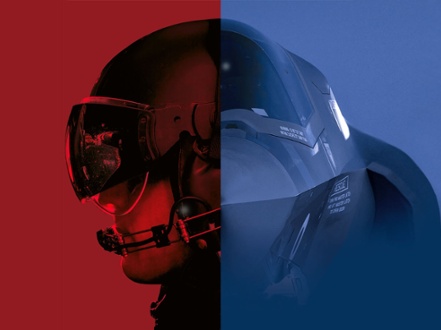
Step inside the future of air power.
InsideAIR goes behind the wire at Dstl’s Porton Down site to explore how science, technology and innovation are helping shape the RAF of tomorrow.
Following the publication of the Defence Investment Plan, this episode looks at the vital partnership between the RAF, industry and research organisations driving future capability.
As Dstl celebrates 25 years of innovation, hear more about the cutting edge of defence science and technology.
Listen on your favourite podcast app or on our dedicated podcast page.
InsideAir Podcast Episode 145 Transcript
Please note that this transcript is automatically generated, and may have some errors. The original audio is the authoritative wording.
Narrator: Standby for broadcast. Standby for broadcast. You're listening to Inside Air, a 'behind-the-wire' view of the Royal Air Force; its people, technology, and operations.
Flight Lieutenant Chris Sully: Hi, I'm Flight Lieutenant Chris Sully, and welcome to the latest RAF Inside Air podcast. Since we last caught up, the Defence Investment Plan, or DIP, has been published, focusing on the move for the RAF to become Europe's first sixth-generation air force. Technology will be front and centre of the future of the RAF, and with that comes even closer ties with our industry and research partners.
Amongst those partners is the Defence Science and Technology Laboratory, known as DSTL, and in this episode of Inside Air, we'll go Behind the Wire at their Porton Down base in Wiltshire to see how that might look.
Air Chief Marshall Sir Harv Smyth: The return of great power competition across the globe and the significant and growing threat posed by Russia to the UK and NATO makes this by far the most dangerous period in my 35 years of military service.
Simulation Science Advisor Annabel: The teams analysed the impact of the position of sensors, which is how we detect the presence of the drones, and the effectors, which is how we would then take them down within the base area, considering, for example, obstructions from buildings or terrain to maximize our ability to sense and act.
Project Technical Authority Howard: Why gold plate the options here?
We could go out, for example, if we were buying a training aircraft, I don't know, go out and buy something that's really fast and shiny and absolute newest technology and stuff like that. But if all we actually need to do is to train pilots in it, why does it need to be, I don't know, supersonic?
Does... It wouldn't need to be low observable or anything like that. It's just what it is we need to actually do the job.
Group Captain Colin Welsh: We'll partner with industry really closely to make sure the Air Force is agile, integrated, and ready for the future.
Flight Lieutenant Chris Sully: As usual, we'll also reheat a few stories which could have slipped under your radar, and we'll be finding out who's under the hat this week with AS1 Ben Russell.
Air Specialist (Class 1) Ben Russell: And what's your proudest moment in the RAF?
Corporal Robbins: My proudest moment to date was winning the 2025 Giselle’s Champion and being crowned the RAF Police Best Military Working Dog Operational Team.
Flight Lieutenant Chris Sully: The recently published Defence Investment Plan provides the resources to accelerate RAF modernization and deliver the vision set out in the Strategic Defence Review. For the RAF, it supports investment in next-generation combat air, including uncrewed fighter aircraft, integrated air and missile defence, space capabilities, flying training, and the sustainment of key air mobility and ISTAR fleets, putting the RAF on a pathway to becoming Europe's first sixth-generation air force. Following the announcement on the last day of June, the Chief of the Air Staff, CAS, Air Chief Marshal Sir Harv Smyth, has outlined what defence investment plans mean for the Royal Air Force and its people.
Air Chief Marshall Sir Harv Smyth: The return of great power competition across the globe and the significant and growing threat posed by Russia to the UK and NATO makes this by far the most dangerous period in my 35 years of military service.
The Defence Investment Plan is a significant milestone, much welcomed by all the chiefs, demonstrating the renewed commitment that our government has made to defence, acknowledging the dangerous and unpredictable world we live in today, and the importance of having a strong and capable defence to continue to deter our potential adversaries. 10 years ago, our first F-35 Lightning touched down in the UK, and the Royal Air Force celebrated becoming Europe's first fifth generation air force.
The DIP now puts us on a pathway to becoming Europe's first sixth generation air force, with the funding to develop our own uncrewed fighter jets, which will operate alongside our Typhoons and Lightnings through the next decade and beyond, paving the way to the arrival of the Global Combat Aircraft Program.
Flight Lieutenant Chris Sully: Chief of the Air Staff, Air Chief Marshal Sir Harv Smyth there. The three key areas identified are transforming our armed forces, backing British, and stepping up UK leadership. Group Captain Colin Welsh is the head of the RAF Rapid Capabilities Office. Sir, welcome to Inside Air. What did you make of what CAS has said?
Group Captain Colin Welsh: Hi, Chris. A period of tremendous opportunity, I think, there. We're already actively involved in pulling through huge amounts of technology in my role as the head of the RAF RCO, and the opportunity space is obviously really rich there for the future.
Flight Lieutenant Chris Sully: So that's like a broad picture we've had from CAS.
What does it actually mean for the Royal Air Force?
Group Captain Colin Welsh: So CAS has been really clear in terms of his priorities for the air force, is that we're to be agile, we're to be integrated, and we're to be ready. So particularly, I think from an RCO perspective, the investments in autonomous and in uncrewed systems there is really huge.
There was not only the the autonomous fighter jets that we talked about as part of that announcement. That represents the high part of what we refer to as the high-low mix, where we'll augment and enhance our existing fourth gen, like Typhoon, and fifth gen, like F-35, capabilities with systems that are substantially lower in cost.
And where we, what we do is we fractionate capability. We take elements that used to only be delivered by single complex systems and break them out into multiple, much lower cost systems, in some cases that can be really disposable. So we'll partner with industry really closely to make sure the air force is agile, integrated, and ready for the future.
Flight Lieutenant Chris Sully: You already mentioned fourth and fifth generation. A big push is to move the Royal Air Force toward becoming a sixth generation air force. What does that mean in practice?
Group Captain Colin Welsh: I think that means countering the threat that we see really evidently out there just now. So again, CAS, Secretary of State, PM really clear in terms of what operations in Ukraine and what likely operations in the Strait of Hormuz look like for the future for us.
So it's firstly about being threat aware. It's about being an integrated force, I think, in terms of the sixth gen, and that integration comes at all levels. It's integration of- The technologies and the uncrewed systems that we have our reliance on space systems, and our increasing exploitation of advanced AI systems in the future, integrating them together with our existing suite of crewed platforms to be as effective as possible.
And those CCAs, collaborative combat aircraft, used to be called loyal wingmen, the uncrewed fighter jets that we'll hear so much about in the future. Not just those, but also autonomous collaborative platforms, smaller systems that can take part of the functions that used to be performed by more advanced aircraft and deliver them to augment and enhance them.
Flight Lieutenant Chris Sully: Backing British was another major focus, to boost British skills and British industry, to quote. That's something the RAF's been doing with industry partners for many years, closely working relationships on that front. Surely that can only be a good thing, the announcement is putting more emphasis on that.
Group Captain Colin Welsh: Yeah, it's terrific. We've got a rich history of innovation in an early-stage science technology, in latter-stage research and development running through the core of the, the, the British industry partnerships that we have with defence. It's an absolute powerhouse. We in particular partner strongly with small and medium enterprises, where a huge amount of the innovation happens and can be allowed to grow.
So we provide in our military expertise, the science expertise of DSTL into those SMEs, and those SMEs bring their innovative ideas and their vision of the future together. And by combining those, we can create some really world-class products, not just for the Air Force, but also for export, which obviously has an impact on UK prosperity more broadly.
Flight Lieutenant Chris Sully: You mentioned DSTL. One of the organizations that we already work closely with in defence is the Defence Science and Technology Laboratory, or DSTL. How important is the work that they do for us in defence?
Group Captain Colin Welsh: It's utterly vital. There's been no part of my career, whether it's the, the operational phase of my career, so years ago flying Pumas at low level over Baghdad, DSTL sent teams out to fly in the back of the aircraft with us, connect laptops up to the mission- missile approach warning receiver to actually enhance our ability to be protected from attack from the ground, and also to reduce the number of occasions whereby the, the flares would jettison off the aircraft on the side, thus protecting people on the ground as well.
Middle phase of my career, I'm operating the Reaper over Operation Herrick over Afghanistan, and there's a huge threat to our troops on the ground from improvised explosive devices, and DSTL come out and set up an entire ecosystem to use the synthetic aperture radar on the Reaper to use coherent change detection, a really advanced radar technique, in order to see invisible changes on the ground that the radar could see but the naked eye couldn't, to warn troops about where those IEDs would be.
And then in this part of my career just now, I partner deeply with DSTL. The RCO would be nothing without the support of DSTL and that integration that they offer for every single one of our projects be that from the early days of the RCO's involvement in Tempest, through the Future Combat Air System into the Global Combat Air Program, representing the, the, the sixth gen platform that we'll operate in the future, through a myriad of much smaller projects that the RCO's involved in every single day.
Flight Lieutenant Chris Sully: So a really close working relationship that's only gonna get closer. We've heard what it's like to work with DSTL from the RAF's point of view. There's only one way to find out how things look from DSTL's point of view. I'm gonna visit one of their two sites the one in Porton Down, and to say thank you, Group Captain Colin Welsh, the head of RAF Rapid Capabilities Office, and thank you for your time.
Group Captain Colin Welsh: No problem at all. Pleasure.
Flight Lieutenant Chris Sully: So it's a, a hazy Monday morning, and I've arrived in Wiltshire at Porton Down, the home of DSTL. Peter is the senior media officer. Peter, it's a huge site, and who else is here at Porton Down?
Senior Media Officer Peter: Welcome to the home of the Defence Science and Technology Laboratory. As an organization we have been on this site since around the mid First World War.
DSTL as an organization was actually formed in 2001, so this year we celebrate our 25th anniversary. DSTL began its life as a chemical defence establishment, but now we literally cover the alphabet, so it's everything from artificial intelligence through to underwater systems. We cover every domain. We have two main sites.
We have this site here in Wiltshire, but also we have our Portsdown West facility just outside Portsmouth. And between the two sites, there's around four and a half thousand specialists involved. Our role here is to deliver mission success for the Armed Forces. It's utilizing the best science and technology that we have to give our Armed Forces the operational advantage and the battle-winning edge that will keep them safe, but also help to protect the UK and its citizens.
Flight Lieutenant Chris Sully: Fabulous stuff.
We're gonna meet some of the team involved in that, certainly as far as the, the Royal Air Force is concerned, so lead the way, Peter.
Senior Media Officer Peter: Will do. Thank you very much.
Principal Advisor Emma: Good morning. My name is Emma s- and I'm a principal advisor for the Air Systems Program. So who are we and what do we do? We are a group of civilian analysts, military advisors, and science advisors that work for the Defence Science and Technology Laboratory and the Office of the Chief Scientific Advisor.
More specifically, the analysts here today are part of the brand new Air Systems Program in supporting the air domain on behalf of UK Defence. So our program is just getting started, and we'll be investing over 100 million over the next five years to support the development of future air capabilities.
So our analysts play a really vital role at the heart of defence in ensuring that science and technology is part of the Ministry of Defence decision-making process. And by leveraging those advancements, we make sure that we enhance defence and security capabilities, we mitigate those risks from rapid technological developments, and ultimately, we try to secure the essential funding for key national assets such as skills, infrastructure, and partnerships going forward.
Flight Lieutenant Chris Sully: So Emma, more broadly what does that actually look like in terms of the things you're doing for the Royal Air Force?
Principal Advisor Emma: Our program, the Air Systems Program, has been given the mandate by the Office of the Chief Scientific Advisor to support the development of future air domain capabilities using our research and analysis of air and space part issues.
So we are trying to seek support from industry and academia as part of our five-year plan to develop and maintain the right capabilities to meet those evolving defence and security challenges. As part of this podcast today, our team would like to talk to you a little bit more about the work that we've done so far and the impact that our analysts are having on those emerging concepts, that research and technology, and ultimately delivering those solutions for UK defence problems.
Flight Lieutenant Chris Sully: And presumably this is an ongoing thing.
You've been involved for some time. This is something that's gonna be happening behind the scenes. People aren't gonna know about these things until they see bits of new kit arriving in front of them.
Principal Advisor Emma: Absolutely not, and you probably never know that analyst's involved or as part of that work.
For myself, I've worked in this domain for about nine, 10 years so far, and you probably will never know that analysts have been involved.
Flight Lieutenant Chris Sully: Which is great because all people want to see is the end product.
Principal Advisor Emma: Absolutely. All that we want to achieve is to make sure that those programs are delivered within budgets, that are providing value for money, and solving those problems.
Project Technical Authority Howard: So my name is Howard, and I'm the project technical authority for the Air Operational Analysis and Decision Support Project.
Flight Lieutenant Chris Sully: So what does that actually mean, Howard?
Project Technical Authority Howard: Okay, so my role is to lead the technical and capability aspects of the piece to ensure we've got the right tools and capabilities that we can use to answer the questions asked of us.
I- I've also recently returned from a loan into Department of State where I was an acquisition scrutineer.
Flight Lieutenant Chris Sully: In terms of effectiveness, that must be a buzzword for you to make sure that what you're delivering is what's actually needed, yes, absolutely. This is where we come down to the major thing about it is we're trying to understand what it is we're trying to buy, but we need to do that based on evidence for what it is actually we need to do, how we're gonna fill that requirement, a- and how we can get a decent value for money out of that.
Project Technical Authority Howard: One of the major requirements for operational analysis i- is to provide evidence to enable effective decisions on what MOD actually needs to procure. So we're directed that all decisions should be based on objective truth rather than people's warm and fuzzies. Equally, because we are dealing with public money here, we are absolutely adamant that we must show that anything we procure is the best value for money that we can reasonably achieve. So what do we actually mean by procurement?
So p- procurement covers everything. It's obtaining goods and/or services. So it includes everything from equipment to weapons, spares, infrastructures, to fuel and energy. But I suspect most people are actually probably interested in the equipment side of things. It's the glamour bit. I did mention that government mandates that procurement decisions are supported by business cases.
So a business case is a big document. We start presenting the evidence about why we should go out and buy bits and pieces, supported by a lot of evidence. First of all, we need to know what the requirements actually are, and that's called the strategic case. That any suggested option that we go out to, to fill those requirements will actually do the job it's needed to and is value for money, which is called the economic case.
That is actually commercially achievable, i.e., there's somebody out there we can go and buy it from, which is the commercial case. But it's both initially affordable, i.e., we've got the money in the budget now, and also throughout the life of the procurement. That's the financial case. And
Flight Lieutenant Chris Sully: How much does that decision come into it?
'Cause obviously you're making sure it's future-proof, so you're taking those decisions early on in this process then.
Project Technical Authority Howard: Oh yeah, enormously so a lot of the issues behind things coming into service is people recognize the fact that we might have a shiny idea now, and we might have the money now.
But when you start talking about aircraft, for example, here, the initial purchase price of that is probably of the order of 30% of the overall through life cost of the platform. And these are platforms that have gotta be going on for 30 years, for example. So we need to ensure that we've got the money in the budget throughout to enable us to go and buy that.
There's no point in us going out and spending millions of pounds on a shiny new aircraft if it's just gonna sit in a hangar because we can't afford to operate it. And I did just following on from my last point now. So we've got the management case, and that's actually looking into can we realistically go out and get this into service?
Have we got the capabilities if I should go out and buy it to get it in service, the infrastructure and all those elements associated with it? But there are actually three business cases that we'll go through. There's something called the strategic outline case, which is where the case for the capability need is made and the key requirement is established.
The outline business case that identifies what is likely to be the best value for money option to fill the requirement, and the full business case, which defines the final numbers and how it will actually be delivered. And it's the outline business case that is the largest, most evidence-backed case in the whole lot.
Flight Lieutenant Chris Sully: How does it work, Howard, in terms of defining the capability gap? 'Cause obviously everyone wants the shiniest, newest things, and you guys obviously have to then work out which are the priorities bearing in mind all the strategic planning and budgets that go into it.
Project Technical Authority Howard: That and that's a lot of where operational analysis actually comes into it.
For example, we'll need to establish the need, which we often describe as the capability gap, and that will often come from capability analysis, where we try to understand how well the RAF will be able to undertake its required tasks in illustrative scenarios, both now and in the future. 'Cause obviously we're looking at capabilities that could be in service for 30 years.
This is a classic area in which operational analysis is used to show what we can do and what we are likely to have to do from understanding future threats and the influence of new technologies, for example equally, OA can shape what it is that's required, capabilities will be needed to be able to do how many, what tasks, what range, payload, effect is required to deliver, et cetera.
This is often done through wargaming.
Flight Lieutenant Chris Sully: I was gonna ask because obviously it's a huge thing for the military when they're planning an operation is wargaming and planning what you're going to do, what a potential adversary might do, so you use that same technique?
Project Technical Authority Howard: Yeah, but w- wargaming can be used at any number of levels.
It can be at any scale from a group of subject matter experts discussing how to solve a problem they are faced with through tabletop wargaming, which is the traditional thing with paper maps and counters on it, up to complex multi-user synthetic environments using state-of-the-art modelling and simulation there. The important aspect is that they're opposed, so the other side gets a say in what's happening here. The same wargaming techniques can also be used to identify and test new technologies for solving problems, be that a, a new doctrine, for example, or new technologies themselves. So if some shiny p- idea has come up, we want to be able to test that, that.
Let's do it in a war game, which is relatively quick and cheap to do, instead of spending all the money trying to get it into service and then find out it doesn't actually do what we need it to do. And we'll do that through s- simpler techniques, often using a SWOT methodology. So that's strengths, weaknesses, opportunities, and threats, where we'll get some subject matter expertise, experts together and and they will work through that process to understand elements of the individual options. Because we don't know enough at the moment, we won't know exactly how effective they will be at the strategic out- outline case, but we can often identify and determine their credibility, so sort the wheat from the chaff, as it were. But once we've got that, we'll move on to the operation, sorry, the outline business case.
These options will have been whittled down into one or two credible options, plus some baseline options here. Because we need to determine everything's value for money, we need to demonstrate this baseline against what the situation is at the moment. So if we did absolutely nothing, just let our existing capability fail, that would be called the do nothing capability, but there's also a do minimum option in there, where we're often just doing things like running on our existing capability. Understanding the difference and benefit that our options will provide over those do nothing and do many things there helps the decision makers determine whether buying something will actually offer sufficient benefit to be good value for money in itself. Theoretically, the most cost-effective way to do something is to not do it.
Sounds counterintuitive because although you won't have any effect, you're not actually expending any money, so it's infinitely cost-effective. But obviously, we're gonna need to be able to go and do something out there. If if you don't actually realistically need to do it, you have to ask yourself a question, are we spending this money here for no benefit that we can actually get away without doing? That's often where the do nothing capability comes in. But if you've got a, an obligatory task or something that's a really high priority, for example, pilot training, we're often gonna actually have to actually go out and spend some money to get some equipment in, otherwise we won't be able to do what we need to do in the future.
And in doing that, it's very necessary to set bounds about what it is we need to do. We tend to set a minimum requirement, which we call the threshold, and a maximum requirement, which we call the objective. So buying more than we need, i.e. exceeding the objective, will be unlikely to offer value for money even if it is cost-effective because we don't need it. So why buy stuff that we don't actually need?
Flight Lieutenant Chris Sully: If it's just gonna sit on a shelf somewhere effectively or in a hangar.
Project Technical Authority Howard: Exactly, yes. Why gold plate the options here? We could go out, for example, if we were buying a training aircraft, I don't know, go out and buy something that's really fast and shiny and absolute newest technology and stuff like that. But if all we actually need to do is to train pilots in it, why does it need to be, I don't know, supersonic? Does-- It wouldn't need to be low observable or anything like that.
It's just what it is we need to actually do the job. Also, we might impose limitations or prerequisites on options. For an example, it might be that it needs to be made in the UK so that we have operational freedom and are not dependent on another nation for buying or maintaining that capability. For example, if we bought from a third-party nation, they could prioritize our, their own needs, so we'd sit further back in the build cycle of it, or it might become unavailable for whatever reason. We also bring in this concept of societal value.
What is it that's actually demonstrating value to the nation as a whole? It may be more valuable to the nation to maintain or build on industrial capability, i.e., we spend a bit more now, but we get so much more societal and whole nation benefit out of it because we can keep that industry going. We can keep jobs in that industry.
Flight Lieutenant Chris Sully: So we're talking ultimately, yeah, literally about jobs- Yes ... and sustainability of UK industry.
Project Technical Authority Howard: Yeah, absolutely. It can come down to that, and a lot of decisions are made explicitly about keeping a capability to do something in the UK. '
Flight Lieutenant Chris Sully: Cause once you lose those skills, they're gone forever. We've seen that in shipbuilding, for example and other industries.
Project Technical Authority Howard: Yes, indeed. And the, the shipbuilding is being brought back up, but there certainly was a decline in it previously. But another big net area we need to assess is risk. So no procurement is without risk. Something can always go wrong, but we do try to minimize it where possible. However, there may be times when the need is so great that it overrides concerns about costs or timeframes.
For example, if we need to get something into service really quickly to counter a threat, we might not necessarily get the most cost-effective option, but we'll get the one that we can get into service quickest to deliver the need that we want to be able to do. In these situations, going for the risky option is not intrinsically bad. Say, for example, where the risk to UK capabilities of not buying something is greater than the risk of the co- cost overruns. This can often and does happen with operational requirements at times
Flight Lieutenant Chris Sully: Just one last question for you, Howard. You ... So many different elements there, cost, effectiveness, risks timelines, everything else.
How do you avoid, as a team, paralysis? 'Cause it would just be easier sometimes to just go, "This is all too difficult," put it in the too difficult bucket and leave it there.
Project Technical Authority Howard: So yeah, we're often dealt with very large and very complex situations that we need to deal with. And one of the real tricks of a- analysis here is trying to dig down into what actually are the really most important influential bits.
So we often use models to do something here, and modelling is an abstraction of reality. If it was perfectly representative of reality, it would be a reality in its own right. But in setting up and building that model, we will be spending a lot of time carefully looking at what are the most important aspects of it, and those are the bits that we'll focus on.
Once you've got that focus there, you've very much reduced the amount of analysis you'll actually need to be able to do, whilst still sticking with the important parts of the question. And that's a, one of the primary techniques about operational analysis.
Flight Lieutenant Chris Sully: And presumably, w- we're all hearing more and more about AI and l- language learning models and things.
Is that making a big difference in the work that you do?
Project Technical Authority Howard: It really is starting to, yes. So I think it's important to note that we won't use the AI to make decisions for us at this point here. Those decisions will still need to be made for the appropriate people. But the AI can be used for example, large language models can really be used to help us understand and whittle down a- and focus in on the bits that we really need to understand, and take away some of the more mandraulic, nausea inducing bits and pieces that we actually have to do.
Anything that can save us time and effort and help us focus in to those important bits- About making decisions and providing analysis about the important aspects of it all of the goods. And we're really seriously putting a lot of effort into developing those tools to help us inform decisions better.
Flight Lieutenant Chris Sully: Other than AI, presumably industry partnerships, which we hear about in the MOD and across the, the range, are becoming more and more important to you as well.
Project Technical Authority Howard: Oh, absolutely. So we are putting more and more work out to our industry partners as part of analysis here. We in DSTL will need to keep inside those bits that need to be done in government, which I can't really go into at this point here, obviously here. But there's a lot of stuff, and increasingly more and more, that we can ask industry partners to help us with. And in fact, we're in the process of setting up what we're calling a, a capability partnership here, where we are getting people working with us closer so we can share the capabilities. They can share what they know, we can share what we know here.
Also, it's important to note that a lot of the modelling stuff that we do here, especially on the wargami- gaming side of things, often uses in- industry models here. There's a lot of w- there's a couple of war games that sit within DSTL that are based on commercial games, and they're, those commercial games themselves are so good that actually we can, with a bit of finagling around to get a bit more detail into it, really get some very, very top-notch analysis here. And obviously, industry have spent all the time and money on doing that. We might as well utilize the best tools that we can get available here.
Flight Lieutenant Chris Sully: And just lastly for you personally, when you've worked on a project, you've gone through all the analysis, and the cost effect, and the career, and all the other bits and pieces you've talked about, and you see something come into effect, and it goes out, without talking about specific equipment, that must be a real buzz for you as to being part of that team.
Project Technical Authority Howard: Oh, yeah, absolutely. In fact there's multiple bits and pieces that I've seen through service sorry, into service. And actually unfortunately I've been at it so long, I'm seeing stuff coming out of service now. But that's fine. That's all about military procurement is trying to understand and getting the equipment and the kit that you need to solve a problem now.
But yeah it's great to see something actually finally getting into service. W- could be small, could be big, and actually seeing people being able to get a hold of it, realize the benefits that this can provide for people, the benefits in terms of effectiveness, but also in terms of i- improvements in comfort, in safety.
Massively safety's a huge bit about it. And just making sure that the people on the front line can deliver what it is they need to do as well as they can and as safely as they can.
Operational Analyst Neil: Hi, my name's Neil. I'm an operational analyst in the DSTL Strategic Analysis Capability. So I'm the lead for the control of the air and attack work package, part of the Airway and Decision Support project.
My work package, as the name suggests, provides analysis to support decision-makers on the RAF's future capabilities, both in the control of the air and attack roles.
Flight Lieutenant Chris Sully: Specifically in, to what you can talk about, what kind of platforms do you work on, Neil?
Operational Analyst Neil: Yeah, so that typically covers things like Typhoon, F-35 the weapons associated with those as well.
We also look at some of the future platforms as well, so it's things like the Future Combat Air System, so FCAS.
Flight Lieutenant Chris Sully: So we'll come back to FCAS in a moment. So Neil, when it comes to the inquiries that come through from the, the Royal Air Force, what kind of things are they asking of you?
Operational Analyst Neil: Yeah, so the sorts of questions we get asked are how many combat air squadrons do we need to meet policy?
So what's the most cost-effective force mix of kind of crewed, uncrewed, and crewed platforms? And the other mo- common one is when platform X reaches our service date what's the most cost-effective option to fill that capability gap?
Flight Lieutenant Chris Sully: Your work is, a- again, a bit like when we were chatting a, a moment ago with Howard, is split between the operational and budgets again as well.
Operational Analyst Neil: Yep. Yeah, that's right.
Flight Lieutenant Chris Sully: You're working on a project, something lands on you. So what kind of techniques, what kind of systems do you apply?
Operational Analyst Neil: Yeah, so my work package uses a variety of different techniques from the whole OA hierarchy. So at the very top level, we use force mix analysis and campaign analysis, and then we bring that down into kind of- Just
Flight Lieutenant Chris Sully: explain those a little bit more.
Operational Analyst Neil: Okay. So force mix analysis is different numbers of Typhoon, F-35, alongside ACPs and un- sorry, uncrewed platforms, things like that. So how many of those do you need? What's the most cost-effective mix of those? And I then use things like campaign analysis, which is why you take a, a large scale scenario, say it's like Gulf War I, and kind of model all the various different elements within that, all the different coalition partners and work out what campaign success looks like.
We then take that down a level into kind of the mission level, so within, say, a, a strike package against an individual target. So what's the most effective mix of platforms to achieve that effect? And then down to the individual one-on-one type engagement yeah, one aircraft against another aircraft kind of thing.
Flight Lieutenant Chris Sully: And presumably, that's a constantly evolving thing. So an analysis you did six months ago might not be valid. You constantly have to revisit potentially. It, obviously, the threat's evolving constantly, so we need to keep a track of that and, yeah, represent the latest threats as, as they come through.
Neil, we-- you've mentioned the phrase FCAS already. When we talk about FCAS, explain to somebody who doesn't know what does that mean, and what does it involve for you here at Porton Down?
Operational Analyst Neil: Yeah, so FCAS, that's the program to deliver a system solution to replace Typhoon when that reaches our service date in 2040.
So the, yeah, assumed solution at the moment is a mix of crewed, uncrewed platforms. So our support to FCAS actually predates the formal start of the program. So back in 2015 we undertook a architecting study which looked at the basic elements to represent an air defence mission.
So we then tested their ability to deal with future theoretical threats given a set of constraints, and concluded that a, a crewed platform was essential to meet future air defence missions. This kind of provided a initial set of evidence to the FCAS strategic outline case. So that's the initial business case that kicks off every, any, every government program, which we then built on with additional analysis looking at what the capability gap looks like when Typhoon reaches our service date.
Are there any viable solutions out there? We could then provided addit-operation analysis to articulate the policy need illustrate the combat air capability gap and future threats, and undertook some initial effective analysis to look at different potential options to meet that gap So as the program's matured we provided a way to support on specific requirements, so looking at the reach, so how far does the platform or the, the capability need to go; persistence, so how long does it need to stay there; looked at speed; weapons, both in terms of the numbers of weapons and the, those types of those weapons; the sensors, so what types, how many where they should be placed, what frequencies it should operate under, that kind of thing; and what's the kind of survivability strategy, so how is it gonna fight into and out of future threats.
To support these, we've used a variety of different techniques from operate-in-the-loop combat simulations Monte Carlo constructed simulations, judgment events, s- such as tabletop exercises, war games, and also down to your very basic spreadsheet analysis.
Flight Lieutenant Chris Sully: When we talk about effectively sixth-generation platforms and things, for most people, anyone that's been to RIAT over the last few years will have seen Tempest, a mock-up of Tempest parked there.
Is that what we're describing here at the moment?
Operational Analyst Neil: Yeah, that is a key part of it. So the, the Tempest is the crewed platform, the crewed element of FCAS, yeah.
But using swarming drones and other- yeah ... systems to-
Alongside uncrewed ACP, so autonomous collaborative platforms.
Flight Lieutenant Chris Sully: We're sitting here at Portland Down on a, a Monday morning.
What's in the pipeline for you and the team?
Operational Analyst Neil: Yeah, so looking ahead, we're gonna be providing operation analysis to support some of the, the future decisions they got coming up on the program, so we've got the strategic requirements review happening next year. We've got analysis to assess some of the concepts that are coming out from industry and Edge Wing and s- assess whether they meet our requirements.
We're gonna be potentially undertaking some analysis to support some of the requirements trades that'll be needed as part of that. And yeah, and also some analysis to look at the optimum mix of crewed, uncrewed to meet some of those requirements as well. So yeah, lots of exciting analysis to come.
Flight Lieutenant Chris Sully: For you personally, being part of a team that's working on such an important project and obviously protecting UK far into the future, what does it mean to be part of that team developing that?
Operational Analyst Neil: I love it. I've got a great team working with me. It's lots of exciting work, yeah.
Flight Lieutenant Chris Sully: And presumably one of those things where sometimes you one step forward, three back, at other times a bit more progress and stuff.
It must be frustrating.
Operational Analyst Neil: Yeah it can be, but I think when you're looking at what you're working on, it's just so interesting, yeah.
Flight Lieutenant Chris Sully: Yeah. And eventually, at some point, to see the the system launch in whatever format it takes by the time it's developed and and there, what will that feel like that day?
Operational Analyst Neil: Yeah, hopefully I'm still around then.
Simulation Science Advisor Annabel: Hi, I'm Annabel. I'm Air's Modelling Simulation Science Advisor. I work for MOD's Chief Science Advisor, and I support Air Command's efficient, proportionate, and appropriate use of M&S in the development of its capability.
Force Development Scientific Advisor Mitch: Hi, I'm Mitch, the Force Development Scientific Advisor in Air.
I run a range of scientific advice and guidance from high-level air domain concepts through to the force development capabilities that are there to realize them.
Chief Modelling and Simulation Officer Ruari: Hi, I'm Ruari. I'm Air's Chief Modelling and Simulation Officer. My job is to try and make sure that wherever we're using simulators or simulations or modelling within Air, it's coherent, and we can share models, data experience across the whole of the air force.
Simulation Science Advisor Annabel: How do you prepare and shape the RAF to meet today's challenges while ensuring it's ready for the future? To try and answer this question, let's break it down and think about the things, some of the things you would need to understand. Firstly, our current and future threats and what we need to prepare against them, the capabilities you already have and what you need to do with them, and therefore what you may need to invest in based on the threat picture, the tactics and effects associated with these capabilities and how you would plan to use them in different scenarios, how all of this mix fits together in the RAF with the Army, the Royal Navy, and the Cyber and Specialist Operations Command, known as CSOC, and finally, how this mix would fit in an even bigger system among allies.
This work all needs to be done while supporting current operations and responding to events as they develop. Now, you can't just buy and fly every possibility or try every tactic. You can't test out most scenarios in the real world because that would expose your capabilities and cost a huge amount of money and resource.
But the decisions still need to be robust, evidence-based, defensible, and future-ready. What do you do? It's not an easy question to answer, and as the world becomes more complex, it's increasingly difficult for the RAF to weigh and process all these considerations in the way that we once would. This is where synthetic environments and user modelling simulation, known as M&S, comes in.
Flight Lieutenant Chris Sully: Annabel you mentioned MS. What is that exactly?
Simulation Science Advisor Annabel: So it's not as complicated as it sounds. It's basically a way of creating a version of the real world or things in it so we can explore questions and test ideas. It could be something small like a computer model of a single part, maybe a screw or a valve in an engineering system, or something much bigger or complex.
Think a digital twin of a Formula 1 car that behaves as closely as possible to the real thing, and you can monitor hundreds and thousands of parts as you race. These are all models in synthetic environments. Another example of models in synthetic environments are video games. Think very simple ones back in the day, like Snake.
To highly immersive virtual ones- That's my level. That's my level Like a VR headset that you see more commonly now. These examples ra- show a range of what M&S can do, and they're all based on their purpose. If we can represent a world, the world we are operating in, the threats we are facing, and their effects on our capabilities, and vice versa in synthetic environments, we begin to be able to experiment with what the RAF needs to do and invest in to prepare and defend.
Question for Ruari: How has the demand for M&S changed in recent years?
Chief Modelling and Simulation Officer Ruari: So defence has used simulators and simulations for years. The first aircraft simulator arrived during World War II, and we've also used sandpits and models to simulate and rehearse missions for many years. But our approach has always evolved in line with technology, and we now use capabilities like extended reality to help train our people how to operate aircraft or to maintain equipment, for example. From another perspective, security constraints and the sheer complexity of modern operations mean that we simply can't do capability development, tactical experimentation, or operational training in the live environment.
Using synthetic capabilities such as simulators and digital sandboxes mean we can develop and test new capabilities and tactics better and faster, and in greater security than we used to be able to do. So simply, there's an increasing demand for modelling and simulation because we simply can't do everything that we used to do in the live environment anymore.
Flight Lieutenant Chris Sully: All well and good. Fantastic stuff. Have you got an example you can share with us?
Simulation Science Advisor Annabel: Of course. So at DSTL we have advanced framework for simulation, integration, and modelling, which we refer to as AFSIM. It's a capability the RAF leverages from the analysts, which was kindly shared by our partners in the US.
The team recently modelled defending our UK bases at home and abroad with our allies overseas against uncrewed air systems, which you may also hear referred to as drones. These are a fast-evolving threat, and therefore we need to act quickly to sufficiently prepare our personnel. The teams analysed the impact of the position of sensors, which is how we detect the presence of the drones, and the effectors, which is how we would then take them down within the base area, considering, for example, obstructions from buildings or terrain to maximize our ability to sense and act.
The analysis done by the team has now been turned into a tool to automate the process of creating optimal position laydowns for base defence. Without this tool, changing the laydown of the bases would've been a large undertaking and required testing solutions unique to each base. So- So
Flight Lieutenant Chris Sully: it's saving time and it's saving money and it's saving effort.
Simulation Science Advisor Annabel: Yeah, and it's not just being used to We're not using, just using it to analyse problems, but to, for the RAF to generate rapid, usable, and innovative solutions to evolving threats, and this will then in turn influence our design of systems in the future And can really be extrapolated for highly dense urban environments, not just bases.
So Mitch, from your perspective as the Force Development Science Advisor, where do you see M&S having the biggest impact on Air's future force development?
Force Development Scientific Advisor Mitch: Personally, I think M&S has its greatest impact by fundamentally changing the scale. Probably also the depth and relevance of the evidence we can generate to inform force design and development activity.
I think pace comes into that as well. The ability to generate fast iterations of activity in a short period of time really helps to enhance the ability to develop an effective evidence set. It allows us to move beyond the limits of live experimentation, and I don't mean that by live experimentation being a bad thing.
I'd say it's limited in terms of cost and resource. So the ability to operate in a variety of environments through time and scale, I was gonna say, time must be a big element of that as well.
Yeah, a huge element of it, and also the ability to cost effectively address these iterations is really quite an important aspect to this.
That generally tends to give far greater confidence in our ability to generate the evidence and our understanding of the evidence set itself. I think when you're combining real world testing activity from a singular event and then expanding that further, the ability to stress test and interrogate across a much wider range of scenarios in the synthetic environment is really deeply useful It's enables exploration of future capabilities as well.
So where we haven't got the ability to test these in a live environment yet, things like uncrewed teaming or next generation systems, the ability to use synthetic environments to understand these to a far greater detail is really quite a useful tool to have in the arsenal. Equally, we're seeing this integrated into wargaming activity.
You heard Annabel mention there the AFSIM. We're starting to demonstrate this through Five Eyes AFSIM activity, where operator decisions can be analysed and iterated in near real time. The result of this, higher fidelity wargaming, in my perspective, more effective experimentation, and a much stronger analytical foundation for future force development.
Simulation Science Advisor Annabel: So to, to pull on that point, Mitch, it's really about giving the RAF a way to think ahead properly and understand the impact decisions and investments combined with the deep air domain knowledge that we have. Though the future is uncertain, the decisions still must be made now and at pace. And to call out the example that you gave, the AFSIM team have been supporting Five Eyes wargaming, where analysts from the Five Eyes science and technology nations work on the problems of the future and challenging operations in the air domain.
So each nation has becomes- begun establishing their own AFSIM capability and developing what they want to put in it, which they have used for their own independent analytical needs, but also have been brought together as part of a war fighting scenario as a coalition. And this wargaming still does include human in the loop, so real people are controlling the simulated elements that are being represented.
But because the Five Eyes are using this core framework, the system can turn the decisions made by the war fighters into analysis within minutes and be presented back to them rapidly to understand the impact of their tactics. So Ruari, from your perspective, how do you see the impact of using AFSIM and our other operational analysis and decision support tools in collaboration with those domains and our partners across the world?
Chief Modelling and Simulation Officer Ruari: Thanks, Annabel. Just before I answer that, it's probably worth talking about what the Five Eyes partnership is, and effectively, it's exactly as it says on the tin. It's cooperation and collaboration between the five partners the UK, the US, Canada, Australia, and New Zealand in the defence sphere to...
so that we can all move forward together rather than doing everything on our own. And then looking at the impact of tools like AFSIM, we talk about the air, land, maritime, space, and cyber environments as if they're entirely separate domains. But in reality, they're overlapping and interdependent And so the Royal Air Force is gravitating towards using common tools such as AFSIM in a number of areas because they have good capability across all of those physical environments, and because using common tools makes it easier for us to collaborate and share data, models, and insight with colleagues, not just from other services, but from coalition allies as well, and especially in areas such as integrated air and missile defence or autonomous vehicles, where within the UK, all four services contribute to defence’s overall capability.
It's increasingly important to understand how we work as an integrated UK joint force and as part of a coalition, and to develop capabilities and to practice tactics in a secure safe-to-fail environment before we actually have to use them on operations.
Flight Lieutenant Chris Sully: And the safe-to-fail thing is presumably key to this and making-- giving you the room to do that.
Chief Modelling and Simulation Officer Ruari: Yeah, absolutely. We simply can't use our airspace in peacetime in the way w-we would use it for real, and we don't want our aviators to fly in peacetime the the way they would in wartime. But they still need to practice how they would fly on operations, how we would drive land vehicles or operate sea vehicles or UAVs of any kind on operations.
Otherwise, we're not gonna be able to do it properly when we get there.
Flight Lieutenant Chris Sully: There's always that balance, isn't there, right? We did an inside ear a couple of episodes with the team at Sonic recently, and obviously low flying, all of that stuff comes in. You've got a real world scenario to deal with, but you can't always go out into the real world to practice.
Chief Modelling and Simulation Officer Ruari: Correct. And that's not just the flying at ultra low levels, which we do less nowadays, but it's using some of our exquisite offensive or defensive capabilities. Actually, their effectiveness is dependent on the fact that the first time we use them for real is the first time our opponents have seen them, and so they haven't had time to prepare or to mitigate them.
Flight Lieutenant Chris Sully: Mitch, we just heard from from Ruari there about the simulation and doing things in simulation rather than real world. Why should people care about it ultimately?
Force Development Scientific Advisor Mitch: I think I mentioned before about the speed, the credibility, and the enhanced evidence set that can be generated from modelling and simulation.
I think you picked it up with Ruari really nicely there, where you spoke about the highly complex environments in which we're operating in the future, and our ability to understand these environments and the capabilities and the systems by which we're employing in them. That's can be done through live experimentation, as mentioned beforehand, but to truly generate the iterations and the variety of environmental factors, you're simply gonna have to use synthetic data at some point to aid that evidence base and decision-making going forward.
I think it's crucial, those commissioning analysis and delivering it, understanding each other. This understanding over time builds a more analytically literate organization, so the RAF can make more defensible and effective decisions. Just as importantly, M&S helps us challenge our own assumptions. By utilizing a variety of models, we can test them systematically rather than relying on solely on intuition, reducing bias in our decision-making over the longer term.
I would offer, though, no single method is sufficient. Live experimentation, war gaming, military judgment, M&S all have strengths and limitations, and the real value comes from combining them to build a coherent evidence base.
Flight Lieutenant Chris Sully: Mitch, your work here with DSTL, what does it mean to you to be involved in delivering future platforms and systems to people that are gonna make a real difference?
Force Development Scientific Advisor Mitch: I think we mustn't detract from the operator and the war fighter on those front lines being the individual that we are really focused on improving the survivability, the life of. So I think working with DSTL in the background only helps to enhance that. I work a lot with the operational analysis decision support program to understand the wider environmental factors by which our capabilities are employed in, and I think that's so important to ensure that we are picking the right capability, we are picking it in an affordable manner, and we understanding fir- first and foremost, how that's going to aid our ability and the war fighter on the front lines.
Flight Lieutenant Chris Sully: And what about for yourself, Annabel? Similar question. I think the value of my role and what I really enjoy about it is being that translator of science between the lab and between the military personnel. I really enjoy being on both sides of things and really understanding, being able to understand the impact of really deep technical science.
Simulation Science Advisor Annabel: And I think that is the value of the science function of the MOD, to call out the chief science advisor, and the work that science advisors do is making sure that the RAF and the other mi- military commands can use science to their advantage.
Flight Lieutenant Chris Sully: Ruairi, for yourself, we hear all the time in defence about joint partnerships and whole force and everything else.
You're really delivering that at speed and at capacity here, aren't you?
Chief Modelling and Simulation Officer Ruari: Yeah we're certainly trying to. We can't do everything on our own, but defence is often guilty of trying to do everything on its own. Actually, what we need to do is work together with the other services, with coalition partners, with industry, with academia.
We all have our own strengths. We all have our capability. We all have our own weaknesses. But only by working together and sharing as much data, insight, knowledge as possible to support the war fighter, which is what the bottom line is. We are trying to give our guys and gals who go out there and put their lives on the line, the tools that they need to be able to do that and do that successfully.
Flight Lieutenant Chris Sully: And your background was with Tornado Force. Did you ever envisage a day when you'd be involved in projects like this, taking things 40, 50 years into the future?
Chief Modelling and Simulation Officer Ruari: Hey I never would've joined the Air Force to do this. And I really enjoyed my time flying, but I can't fly anymore. The Tornado's no longer in service.
This is a job where I can make sure that the people who replaced me, the people who now fly Lightnings, Typhoons Poseidons, Wedgetails or who operate on the sea or on the land, have the capabilities and the tools they need to enable them to deliver operational success, and that feels like a pretty good reason for going to work.
Corporal Victoria Andrews: This is Reheat for Inside Air. I'm Corporal Victoria Andrews. A Royal Air Force Voyager aircraft has deployed a 68-person search and rescue team from RAF Brize Norton to Venezuela following the recent twin earthquakes there. RAF aircrew and logistics specialists rapidly prepared the aircraft to transport firefighters, paramedics, specialist search and rescue dogs, and vital equipment, helping maximize the chances of finding survivors.
Meanwhile, the RAF Air Mobility Force has played a key role in Exercise Ramstein Flag, one of NATO's largest tactical air exercises. Over 10 days, RAF Voyager aircraft delivered more than 250 tons of fuel across 10 missions, extending the range and endurance of allied aircraft from nations including the Czech Republic, France, Germany, and Sweden.
The operation helped sustain NATO airpower and strengthen interoperability among allied forces, enabling the ability to train at scale and sustain operational tempo across the battle space. Elsewhere, nearly 2,000 military and civilian medical personnel from 32 nations took part in Exercise Vigorous Warrior in Estonia, one of NATO's largest medical training exercises.
Held every two years, the exercise tests how effectively allied nations can coordinate casualty treatment and evacuation during a crisis. The RAF Medical Force deployed its aeromedical staging unit alongside Army Reserve personnel, Defence Medical Command, and NATO partners to practice the full chain of medical care from frontline treatment through to hospital transfer.
And the Red Arrows are undertaking a month-long deployment to the United States in support of celebrations marking the 250th anniversary of American independence. The tour includes appearances across several states and a major international flypast over New York City alongside US and allied aircraft.
Throughout the tour, the team will also support outreach activities designed to inspire future generations through science, technology, engineering, and aviation. That's Reheat on Inside Air.
Flight Lieutenant Chris Sully: Cheers, Vic, and now it's time to find out who's Under the Hat with Ben.
Air Specialist (Class 1) Ben Russell: I'm AS1 Ben Russell, and this is Under the Hat, where we get to know an aviator in less than a minute.
Name you're known by?
Corporal Robbins: My name's Corporal Robbins
Air Specialist (Class 1) Ben Russell: What's your profession?
Corporal Robbins: I'm a military working dog handler at the Operational Capability Unit at RAF Northolt
Air Specialist (Class 1) Ben Russell: What's the best thing about your job?
Corporal Robbins: My favourite part about my job is getting to work with dogs every day, just playing with the dogs and spending time with them
Air Specialist (Class 1) Ben Russell: Hardest part of your job?
Corporal Robbins: It's cleaning the kennels and picking up the poo
Air Specialist (Class 1) Ben Russell: Best location you've served?
Corporal Robbins: The favourite job I've done with him is we went to Op Charter and we supported RAF High Wycombe in a large-scale protest
Air Specialist (Class 1) Ben Russell: What bit of luxury kit do you never deploy without?
Corporal Robbins: The dog
Air Specialist (Class 1) Ben Russell: And what's your proudest moment in the RAF?
Corporal Robbins: My proudest moment to date was winning the 2025 Giselle’s Champion and being crowned the RAF Police Best Military Working Dog Operational Team
Flight Lieutenant Chris Sully: That's all for this episode of Inside Air. Please do give us a review, subscribe on your favourite podcast app, and then join us again soon
Narrator: You've been listening to Inside Air, a 'behind-the-wire' view of the Royal Air Force; its people, technology, and operations.
If you're serving in the RAF and have a story for us, please speak to your unit media and communications officer. Inside Air is written and produced for the Royal Air Force by RAF Media Reserves