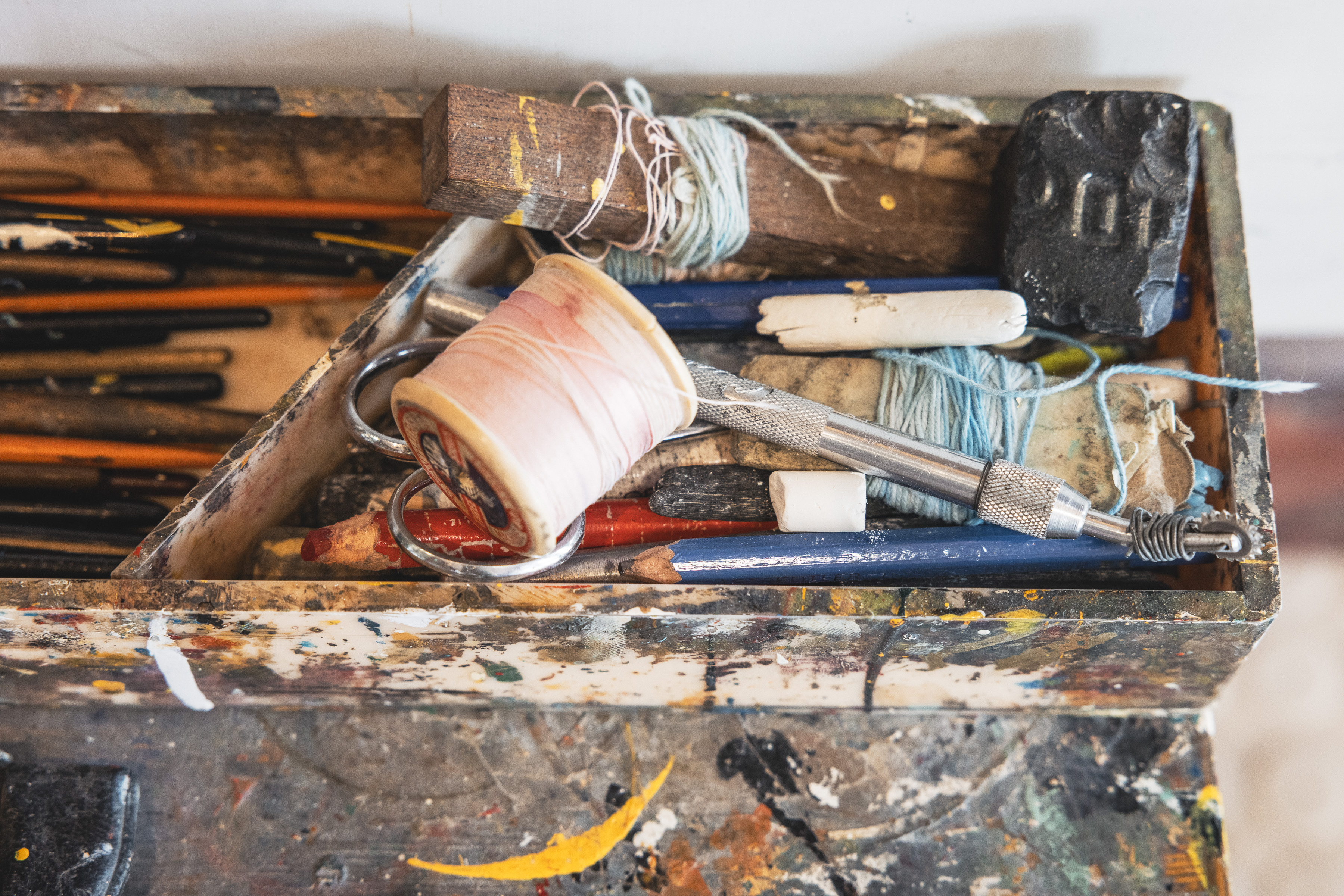
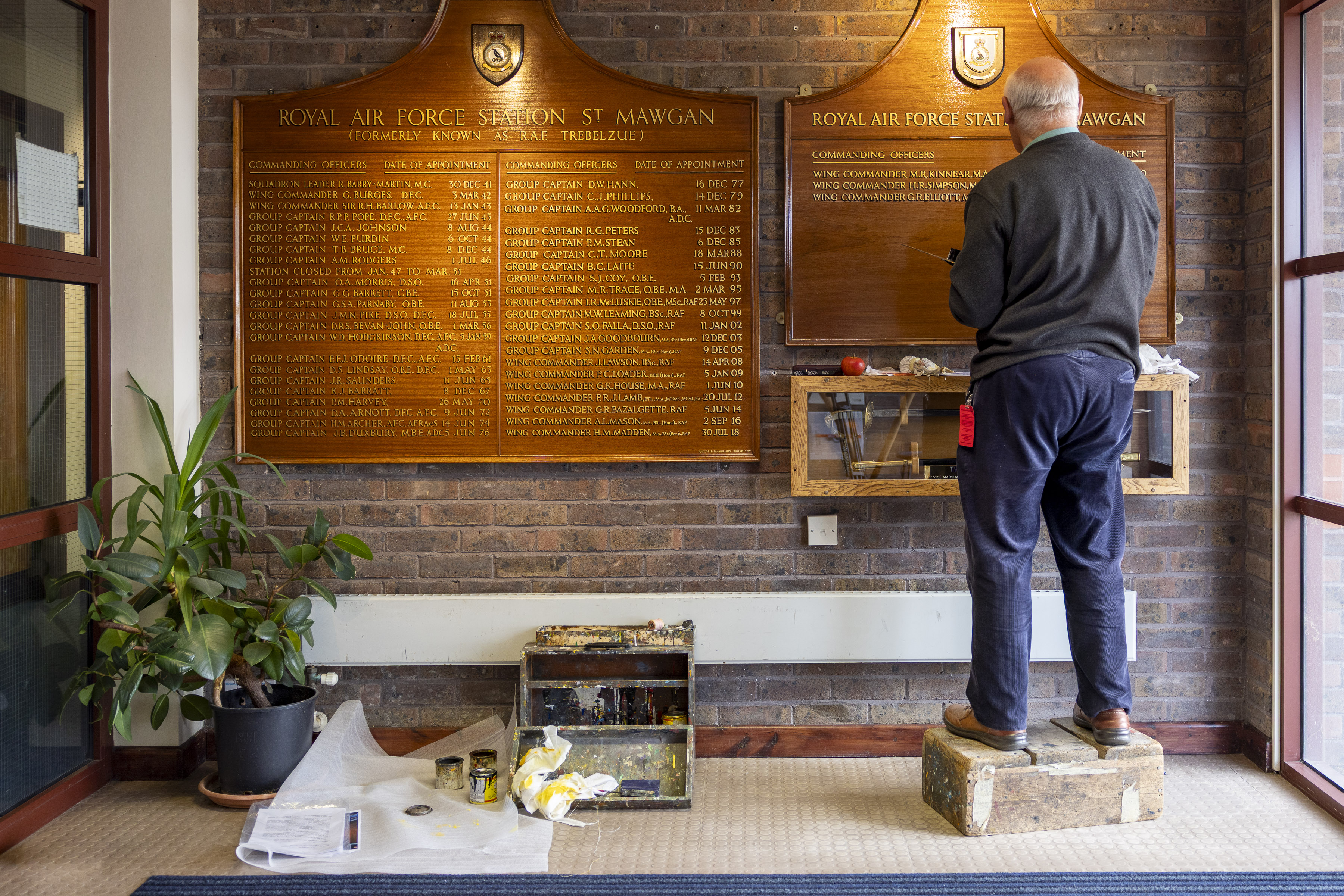
For more than four decades, one quiet but highly skilled craftsman has played a unique role in the life of RAF St Mawgan. Each time a new Station Commander takes up post, it is David Dunkley, a traditional signwriter, who is called upon to hand paint their name onto the wooden Station Commanders’ Board inside Station Headquarters. This is a task that blends precision, pride and deep personal connection.
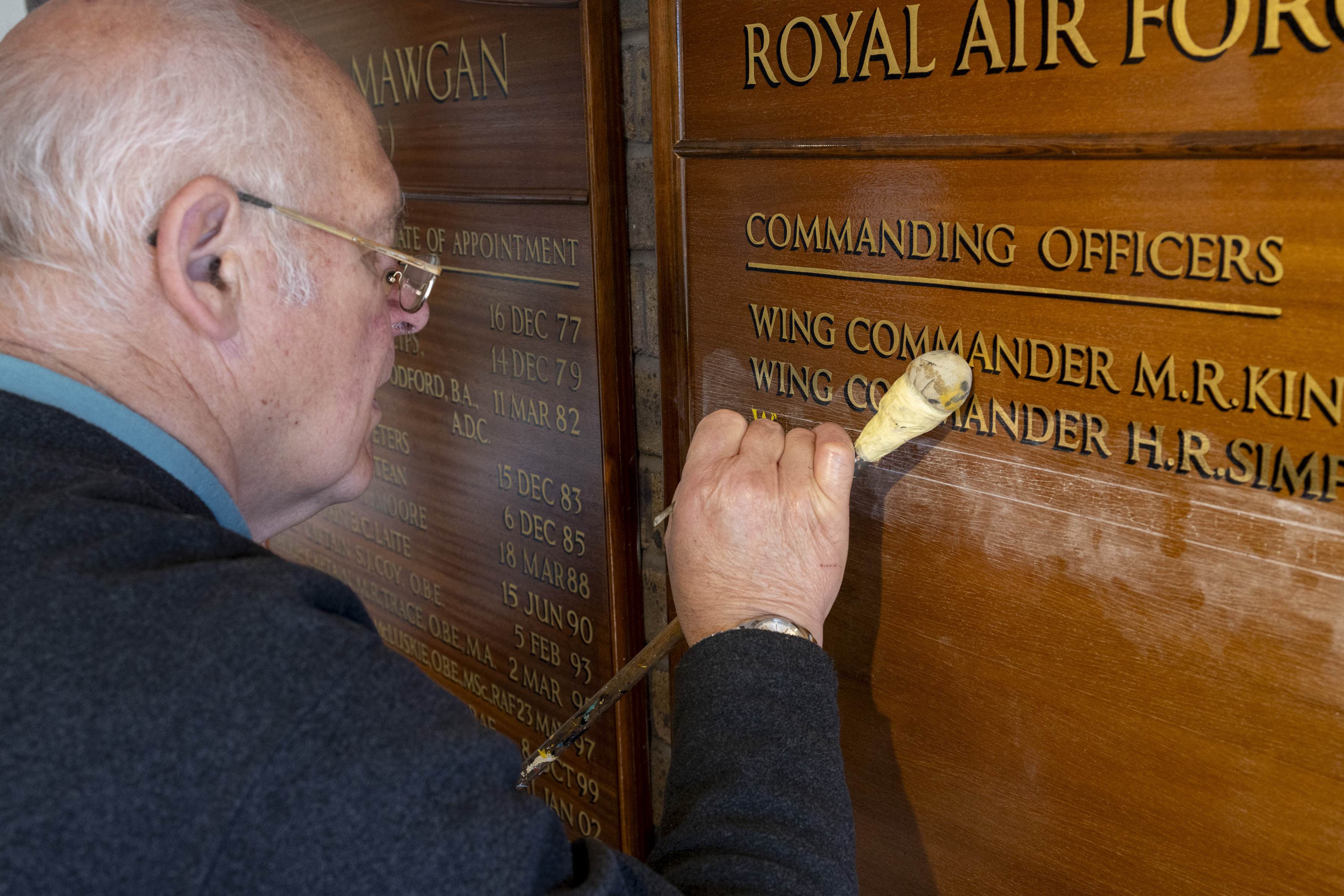
David first painted the Station Commanders’ Board on 11 March 1982, following in the footsteps of two previous signwriters whose styles he recognised instantly. “Each of us has our own fingerprint,” he explains, “You can always tell a writer by their hand”.
His route into the profession began unexpectedly. As a young Scout, David was captivated when visiting a neighbouring troop, by the hand painted birds and lettering in each patrols corner. He later joined his Scoutmaster, an artist and signwriter, helping set him on a career that has spanned decades of enormous technological change.
“Before 1982, everything was created by hand,” David says, “By the early ’80s, computerised vinyl cutting machines changed the industry overnight”. Today, his company Parc Signs, uses lasers, CNC routers, 3D printers, digital presses and advanced design software. Hand lettering now represents less than two per cent of turnover. Despite this, it remains one of the most valued skills. “It’s important to understand the trade from both ends of a computer” David adds.
That traditional expertise comes sharply into focus at military sites like RAF St Mawgan. “These signs are always in prominent places”, David explains, “You only get one chance to make that first impression”.
Once he starts painting, total concentration takes over.
A good signwriter can paint a straight, upright line without thinking about it. I get properly ‘in the zone’, if someone needs my attention, it’s best they make a noise from a distance!
David’s connection to RAF St Mawgan runs deeper than the brushstrokes.
I’m proud to be one of the people who helps create that first impression. When I started, all the Station Commanders were older than me. Now they are all younger than me and include ladies, very much like our own organisation. It’s been a privilege to watch that journey.
Away from military boards, David has lettered and lined over a hundred vintage vehicles, from traction engines to ice cream vans, often recreating designs rich in family history and nostalgia. The technical challenge such as the awkward working positions, complex curves and meticulous lining, is part of the appeal. “When a traction engine is finished, the sense of achievement is enormous”.
There have also been moments of humour along the way from gilding church clocks while fielding unhelpful advice, to accidentally lettering the wrong lorry because it was “new to the owner”, if not actually new!
Despite the dwindling number of traditional signwriters, David remains optimistic. “I don’t think I’m one of the last. There are youngsters trying to follow. They just need practice. Lots of it. You need to be dedicated and don’t give up”. His advice to newcomers is simple. Start with Gill Sans, white on black, 75mm high. “It becomes like riding a bike”.
As RAF St Mawgan continues to evolve, one constant remains, a steady hand, a fine brush, and a craftsman whose work quietly honours both tradition and service. RAF St Mawgan is proud to have David’s craftsmanship continuing a tradition that quietly marks each new chapter in the Station’s history.