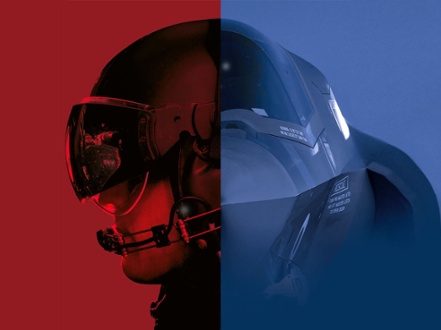
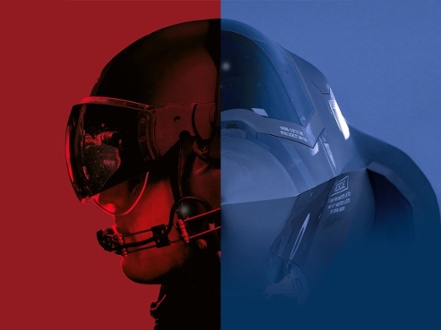
Why does space matter?
Find out why space has become as essential to modern operations as the air, land, and maritime domains, and why securing it matters to every one of us.
Listen on your favourite podcast app or on our dedicated podcast page.
Inside Air Transcript 152
Please note that this transcript is automatically generated, and may have some errors. The original audio is the authoritative wording.
Narrator: Standby for broadcast. Standby for broadcast.
You're listening to InsideAir, a behind the wire view of the Royal Air Force, its people, technology, and operations.
Flight Lieutenant Chris Sully: Hi, I'm Flight Lieutenant Chris Sully, and welcome to the latest Royal Air Force Inside Air podcast. In this episode, we'll find out why space has become as essential to modern operations as the air, land, and maritime domains, and why securing it matters to every one of us.
Wing Commander Neal Henley: I'd like people to understand why space matters to them. The fact that it's part of their everyday life, whether they recognize it or not, but therefore understanding that it is real, it does deliver benefits, but those benefits need to be protected to continue to be able to enjoy them. Number 3 Space Effects Squadron will be established, and it will be the first dedicated squadron supporting our control of space mission. And control of space for us, much like control of the air, is about gaining and maintaining the freedom of action and access to the space domain so that we can deliver those products and services and effects that I talked about, which enable both the integrated force, but also allow society to function as it does on a day-to-day basis.
Flight Lieutenant Chris Sully: As usual, we'll also reheat a few stories which could have slipped under your radar, and we'll be finding out who's under the hat this time with AS1 Ben Russell.
AS1 Ben Russell: What's the best thing about your job?
Under the hat: Being able to take photographs and video in places I'd never get the opportunity to otherwise.
Flight Lieutenant Chris Sully: From navigating a journey with a smartphone to enabling military operations across the globe, space has become an essential part of modern life.
Yet for many, it remains largely unseen. That was one of the key messages emerging from this year's UK Space Power Conference, where military leaders, government officials, industry partners, academics, and international allies gathered to discuss the future of the space domain and the capabilities needed to protect it.
Squadron Leader Amy spoke with the Chief of Staff of the Joint Force Space Component, the operational arm of UK Space Command.
Wing Commander Neal Henley: Hi, I'm Wing Commander Neal Henley. I'm the Chief of Staff of the Joint Force Space Component, and we're the operational arm of UK Space Command.
Squadron Leader Amy: Earlier this month, military leaders, government officials, industry partners, academics, and international allies came together for the UK Space Power Conference.
Hosted by UK Space Command, the conference examined how space is increasingly underpinning military operations, national security, and economic prosperity, whilst exploring how the UK can develop the capabilities, partnerships, and resilience needed to operate in an increasingly congested domain. To help unpack the key themes and announcements, today we're joined by Wing Commander Neal Henley.
Before we get into the detail, for listeners who may not have followed it closely, sir, what is the UK Space Power Conference and why is it so important?
Wing Commander Neal Henley: So the UK Space Power Conference is an opportunity for us to bring together a number of our partners across government, across industry and academia, as well as our international partners to discuss our current thinking, our plans specifically to build on the recently released National Space Strategy, and to collectively advance our understanding of the space domain, the threats, and also the opportunities that are there, as well as our capability development plans and concepts.
Squadron Leader Amy: Let's start with the big picture. What was the overriding message coming out of this year's Space Power Conference?
Wing Commander Neal Henley: So I think there is now a, a growing recognition of the dependency upon space. It's no longer optional. I would argue it hasn't been for a number of years, but people are now recognizing that, and therefore we understand, better understand our vulnerabilities. And therefore that which needs protecting and assuring to ensure that we have access to those services that we need for the war fighter, but also for society who is increasingly dependent and increasingly aware of that dependency on space.
Squadron Leader Amy: We hear the phrase space power increasingly often. So what does that actually mean in practical terms for the Royal Air Force and indeed defence?
Wing Commander Neal Henley: So in the same way that we talk about air power as a combination of the capabilities and the roles and the missions that the RAF deliver and the air domain deliver, space power can be thought of in the same way. So it is about the products, the services, and the effects that we deliver for the joint and the integrated force.
It's about the capabilities and the people, most importantly, that enable the flow of those products and services. So it's awareness of the dependencies that we have, things like GPS, space weather forecasting and warning, and its impacts on both the society and also the military capabilities, particularly on the electromagnetic spectrum.
It's about things like missile warning, space-based earth observation or intelligence surveillance and reconnaissance. Space also enables secure and assured communications, which underpin command and control, especially for an expeditionary or a deployed force. But also within the homeland provides a diversity and resilience of communications paths through using space-based satellite communications, as well as terrestrial communications paths.
That earth observation and intelligence surveillance and reconnaissance underpins the capability to detect, track, and target threats. And more and more relevant now is the reliance upon space for autonomous and uncrewed systems. The combination of communications and precision navigation and timing are key for those systems to actually function effectively
Squadron Leader Amy: One of the strongest messages from the conference was that space is becoming increasingly contested. So what are we actually defending against?
Wing Commander Neal Henley: The space domain comprises of a number of segments. There is the satellites on orbit. There's the space segment, as it's sometimes referred to. There is the link segment, which is those radio frequency and electromagnetic links that connect our ground segment to the space segment.
And then within the ground segment, there is both control and user elements, so like the terminals or the GPS receivers. There are a number of threats to those. We're heavily dependent on those radio and electromagnetic links, so they are vulnerable to both jamming, so disruption, or spoofing, which can change the nature of the signals we're receiving or transmitting.
But also, there is a huge cyber dependency, which is a vulnerability. And equally, the ground systems themselves are vulnerable to f- kinetic or non-kinetic attack to deny their capabilities, which in turn could render a satellite system unusable or un- useful. There are a number of potential adversary satellites on orbit, and one of our key tasks is to detect them, to track them, and to characterize them. A lot of the threat mechanisms that are present on the Earth could also be exported into space, and therefore understanding what the nature of those threat satellites is will help us understand and react to those threats should they materialize.
Squadron Leader Amy: And there was a significant RAF announcement at the conference, No 3 Space Effects Squadron. So what is it, and why does it matter?
Wing Commander Neal Henley: No. 3 Space Effects Squadron will be established, and it will be the first dedicated squadron supporting our control of space mission. And control of space for us, much like control of the air, is about gaining and maintaining the freedom of action and access to the space domain so that we can deliver those products and services and effects that I talked about, which enable both the integrated force but also allow society to function as it does on a day-to-day basis
Squadron Leader Amy: Control of space sounds quite confrontational.
Does this mean that we are preparing for war in space?
Wing Commander Neal Henley: No. Control of space is underpinned by space domain awareness. We need to understand the domain first. But equally, if we wish to deter hostile acts or unwelcome activity in space, we need to be able to detect it, characterize it, attribute it, and if necessary, respond in an appropriate manner.
And therefore, control of space is both about assuring our capabilities, but also potentially denying an adversary those same capabilities.
Squadron Leader Amy: So why should somebody who isn't in defence care about any of this?
Wing Commander Neal Henley: Space is a hidden enabler of day-to-day activity. Most of what we rely upon for modern society has a dependency on space in some fashion. Typically, people will be familiar with satellite navigation, so usually derived from GPS. But the European Galileo system is similar, and there are other systems operated by different nations, both friendly and less friendly. But also, that timing signal that comes from GPS is particularly important for things like the distribution of power, management of water, and things like that.
So it's there in the background. Space is always assumed that it will be there. It's much like electricity. You turn on the light switch and you expect the light to work without necessarily thinking about how it works, and it's the same for space. Similarly, just, things like weather forecasting. A lot of that is derived from space-based systems that provide that the data to enable the accurate forecasting that we now come to expect on a daily basis.
Squadron Leader Amy: I suppose most people would be horrified to think of somebody just turning their internet off. Like you can't even imagine it, right? So the day-to-day functions of everything that we do would be affected.
Wing Commander Neal Henley: Absolutely, yeah. And as I say, a lot of that is down to that GPS timing signal which allows you to synchronize your networks, be they computer networks, traffic management networks, all that sort of thing.
Squadron Leader Amy: What capabilities are actually being developed rather than simply talked about?
Wing Commander Neal Henley: At the moment, we have the Skynet 6 program, which is going to deliver a replacement for the current Skynet 5. Skynet 1 actually launched in 1969, so it's a longstanding name and a satellite communications constellation that has a real provenance. My capability development colleagues are also working on a Project ISTARI, which is our space-based intelligence surveillance reconnaissance, or earth observation.
We are looking at the deep space advanced radar capability, which will give us a radar tracking and detection capability out to the geostationary belt, which is at 36,000 kilometres, and that's where things like our Skynet satellite communication satellites live. So it's important to be able to, again, detect and track the objects that are up there, both from a hazard point of view, so potential collisions, as well as from a threat point of view.
We're improving our space domain awareness through the delivery of the NOCTIS sensors and also through the use of the Borealis mission system, which takes the data from NOCTIS and other sensors and other partners' sensors, and then integrates it to provide us with the domain awareness that we need to make decisions
Squadron Leader Amy: Another major theme was partnership. So why can't the UK simply build sovereign capability and do this itself?
Wing Commander Neal Henley: I would say that we are building and developing sovereign capability, which is important both for industry, for the economy, but also for our freedom of action. But that won't be enough. It won't give us the capacity, and certainly globally it won't necessarily give us the coverage that we need for sensors. And in the same way for other allies and partners, they can do a certain amount themselves at a sovereign level, but they need partners as well to access the rest of the globe. So space is very much a team sport. We work with our partners in Operation Olympic Defender and also in the Combined Space Operations Initiative, and we share data and information, we share perspective, but also we share concerns, and therefore we will frequently communicate with each other and to others about our concerns about activities in space or potentially unwelcome activities that could hazard not just our access to space, but also everybody else's access as well.
Squadron Leader Amy: Now, throughout the conference, we also heard a lot about one space. I know you've just lent into it a little bit there. What does that really mean in real terms?
Wing Commander Neal Henley: So one space is His Majesty's government operating in the most efficient and effective manner, sharing what we do as a department with other departments, and similarly them sharing with us so that we know that we are not paying multiple times for the same product, that if we are acquiring a capability, it's complimentary, or where we are duplicating, it's done deliberately and consciously for good reason rather than accidentally and therefore inefficiently.
Squadron Leader Amy: So pulling all the strands together to be agile, but in space.
Wing Commander Neal Henley: Yeah, to be agile, but also just to be mindful of what is the best value for money approach to get to a, a comprehensive solution that serves everybody's purpose but without wasting resource or time.
Squadron Leader Amy: And I suppose that there is very little of both of those things.
I can only imagine how enormously expensive it is when we're talking about our space assets.
Wing Commander Neal Henley: It can be very expensive, but some of the things is just about reusing either information or systems we already have, so it doesn't all have to come with a big price tag, although the more exquisite the capabilities are tends to be the more expensive they are, but it's not always the way.
Squadron Leader Amy: So industry and investment featured heavily as well. Why is that important to military space power?
Wing Commander Neal Henley: Just as in any of the other operational or war fighting domains, we need to be able to develop the capabilities we need, but we also need to sustain them. And therefore, having an industry that can not just develop and deliver, but to maintain and improve those capabilities is really important as we continue to move into what is not just a contested environment, and increasingly contested at that, but also congested.
The amount of objects in space is only trending upwards, and therefore the risk of a hazard rather than a threat is becoming more and more prevalent, and we need those capabilities to be able to be survivable against whatever risks they face not just against deliberate risks from a potential adversary.
Squadron Leader Amy: You deal in this environment every single day when you're looking at how congested it is in our orbit. There is so much space junk up there. I was absolutely horrified to learn more about that, and that's a real risk for any asset from any country being up there. So what's being done on that front?
Wing Commander Neal Henley: There's a number of international discussions led by our colleagues in the Foreign Commonwealth and Development Office about what constitutes responsible space behaviours and how we can preserve the domain, and by which I mean the orbital regime, for future generations so that they have the access that we've enjoyed. But also, it's about national legislation a- around the globe ensuring that satellites, when they reach the end of their life, are adequately disposed of so that they don't remain as clutter, and therefore a risk to other orbital objects.
Squadron Leader Amy: If there was a military lesson from the conference, what would it be?
Wing Commander Neal Henley: For me, it's the positive is the growing understanding of the significance of space and the space capabilities. But at the same time, it's the need to fully understand your own dependencies which could become vulnerabilities, and therefore understanding why we need to invest in the space domain to ensure that those services people depend upon will be there when they're actually needed.
Squadron Leader Amy: And for people listening to us today, what would you like them to take away from the conference that happened this year?
Wing Commander Neal Henley: So yeah, I'd like people to understand why space matters to them, the fact that it's part of their everyday life, whether they recognize it or not. But therefore, understanding that it is real, it does deliver benefits, but those benefits need to be protected to continue to be able to enjoy them.
Squadron Leader Amy: And finally, what's going to happen next? What should we be keeping our eye on?
Wing Commander Neal Henley: For us now, the challenge is taking the strategy and the investment and turning it into a real executable plan that we can deliver, and that will give us the outcomes that we want to continue to enjoy the benefits of the space domain.
Squadron Leader Amy: And are we on track?
Wing Commander Neal Henley: I believe so, but it's early days.
Squadron Leader Amy: Sir, thank you very much for your time today. Thanks, Emma.
Corporal Emma : I'm Corporal Emma Kerwin, and this is Reheat, where we take a look at some of the RAF stories you might have missed. RAF Brize Norton has welcomed the signing of a £190 million extension to the A400M medium-term contract. Delivered by Airbus, the agreement ensures the continued maintenance, repair, and support of one of the RAF's most important operational capabilities.
Whether it's dropping humanitarian aid, responding to disasters, or flying NATO missions, the Atlas team is set to keep making an impact worldwide. Next, an end of an era for Typhoon operations over Iraq. As Operation Inherent Resolve draws to a close, it marks the end of a defining 12-year chapter for the Royal Air Force, whose personnel have served across the Middle East since 2014.
From early humanitarian airdrops to sustained operations against Daesh, thousands of service members answered the call in one of the RAF's most enduring modern missions. While Operation Shader continues overall, Typhoon Commander Group Captain Paul Hansen OBE says Typhoon's part over Iraq concluding represents an important milestone.
After three and a half weeks of intensive multinational training, Exercise Cobra Warrior has concluded, having generated 942 sorties and more than 2,500 flying hours across 14 missions. Around 1,800 personnel from the UK, Germany, Italy, the Netherlands, and the US took part in one of the UK's most demanding air exercises, testing the ability of NATO forces to integrate and operate together at scale.
An RAF Poseidon has helped to rescue a fishing vessel in Orkney. Personnel from RAF Lossiemouth's 201 Squadron were on a routine training flight when the aircraft answered an alert from the boat that had run aground. And the nominees for the 2026 RAF Sports Awards have been revealed. Triathlete Sergeant Adam Baker, swimmer Corporal Kyle Booth, and sprinter Air Specialist Class One Cameron Tindall are in the running for Sportsman of the Year.
The winner will be announced at a special ceremony on the 22nd of October. That was Reheat for Inside Air.
Flight Lieutenant Chris Sully: Thanks very much, Emma. And now it's time to find out who's under the hat with Ben.
AS1 Ben Russell: I'm AS1 Ben Russell, and this is Under the Hat, where we get to know an aviator in less than a minute. Name you're known by?
Corporal James: Corporal James.
AS1 Ben Russell: What's your profession?
Corporal James: Media specialist, RAF Halton.
AS1 Ben Russell: What's the best thing about your job?
Corporal James: Being able to take photographs and video in places I'd never get the opportunity to otherwise.
AS1 Ben Russell: Hardest part of your job?
Corporal James: Convincing somebody to be in a photo sometimes can be quite a challenge.
AS1 Ben Russell: Best location you've served?
Corporal James: Romania, because the weather and the food was great.
AS1 Ben Russell: What bit of luxury kit do you never deploy without?
Corporal James: I have a bottle of lavender oil made by a really nice lavender farm, and I love to deploy with that because it smells great.
AS1 Ben Russell: And what's your proudest moment in the RAF?
Corporal James: Proud moment for me was covering the Queen's Jubilee, the Queen's funeral, and the coronation. Having those three opportunities was a real unique experience.
Flight Lieutenant Chris Sully: That's all for this episode of Inside Air. Please do give us a review. Subscribe via your favourite podcast app and then join us again very soon.
Narrator: You've been listening to InsideAir, a behind the wire view of the Royal Air Force, its people, technology, and operations. If you're serving in the RAF and have a story for us, please speak to your unit media and communications officer.
Inside Air is written and produced for the Royal Air Force by RAF Media Reserves.