"Let me be clear: this will not deter the UK's commitment to defend NATO, our allies and our interests," said John Healey, Secretary of State for Defence, in response to a Russian interception of an RAF Rivet Joint.
Individual liberty. Rule of law. Democracy. Human rights.
These are the founding principles that bind NATO partners together, the common values that define the approach of the RAF, our allies and our partners.
But those values are not without challenge.
2026 has already seen Russian incursions into NATO airspace, triggering Quick Reaction Alerts, while Russian submarines and ships have entered UK waters, threatening the security of vital underwater infrastructure.
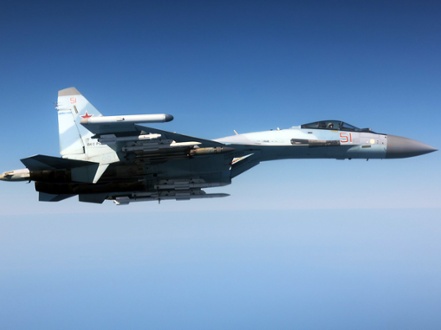
During May, NATO witnessed two of the most serious escalations yet: firstly, while operating in international airspace over the Black Sea, an unarmed RAF Rivet Joint aircraft was intercepted by two Russian jets. In the words of Air Chief Marshal Sir Harv Smyth: the "reckless and unprofessional airmanship of the Russian Air Force," created significant risk and the potential for dangerous escalation.

Secondly, while attacking Ukraine, a Russian drone struck an apartment building inside Romania, a NATO member since 2004.
Actions that risk further escalation, threaten critical national infrastructure, and undermine the sovereignty of free nations cannot go unanswered. They illustrate, clearly and urgently, the need for a collective commitment to defence.
The words of the Secretary of State for Defence illustrate the RAF's commitment to the principles that unite NATO allies has not wavered. It will continue to work and train alongside its valued partners and be ready to defend those shared values.
Strength in Numbers
Operating with allies brings two clear and complementary benefits: improved interoperability, enabling greater effectiveness and knowledge sharing; and visible, collective deterrence. But these are not abstract concepts, they are built through shared experience, repeated exercise and genuine relationship.
That relationship was on vivid display in February 2026, when the RAF's Music Services performed alongside the French Air and Space Force (FASF) at Base Aérienne 107, to mark 90 years of the FASF. It was a celebration of shared history, and a reminder that partnership is expressed in many registers.
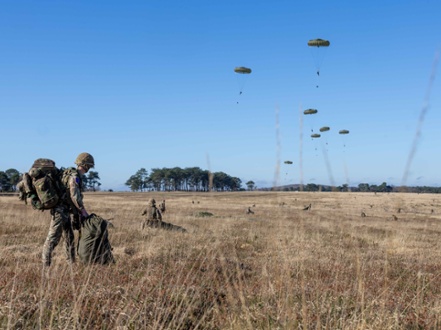
In that same month, over 2,000 French, British and Italian personnel took part in Exercise Orion, putting that partnership to a more operational test. The RAF's contribution was significant: "delivering long-range, precision air mobility at pace, putting paratroopers, equipment and essential stores exactly where they were needed," as one RAF pilot described it. Two A400M Atlas aircraft formed the backbone of the operation, the first delivering French and British paratroopers, the second dropping vehicles and 18 tonnes of rations, ammunition and equipment by parachute.

These activities are not isolated events. They build on the foundations of Lancaster 2.0, a formal commitment between the FASF and the RAF to ensure, in the words of Air Chief Marshal Sir Harv Smyth, that "both continue to enhance our operational capabilities, promote Anglo-French relations and uphold our shared commitment to global security." Agreements like this do more than set out intentions; they are a living expression of the values both forces share.
Hymn Sheet
Three months after performing together in France, the RAF Music Services and the FASF came together again, this time at Lincoln Cathedral, for a joint performance that embodied a principle at the heart of both services: that disciplined, regimented teamwork creates the conditions for individual brilliance.
The occasion served as a fitting metaphor for the broader Anglo-French relationship. To produce the kind of music heard beneath those ancient, vaulted ceilings requires genuine trust, deep mutual understanding and shared principles. The same is true of the alliance itself.
That spirit of partnership finds its clearest expression in both nations' commitment to NATO and the Coalition of the Willing, and their shared belief in Ukraine's right to sovereignty. It is a commitment that has been tested and has held.
"Despite interference, RAF personnel continued to deliver the task in support of NATO," said Air Chief Marshal Sir Harv Smyth in response to the Rivet Joint incident.
It is a commitment that endures, in the air, on the ground, and on the concert stage.
Fin.