“A study in the 1950s1 established human beings only have 5-7 chunks of conscious capacity,” shares Air Commodore Rob Caine, “with really exceptional people having a capacity of 9.” This is why as many things need to be “stored in the unconscious competence box as possible.”
The use of synthetic training to help speed up the development of trainees has a long and storied history. The RAF saw its first use of simulated training in 1910, with a model cockpit. It wasn’t until the 1950s that a computerised simulator was built for pilots.
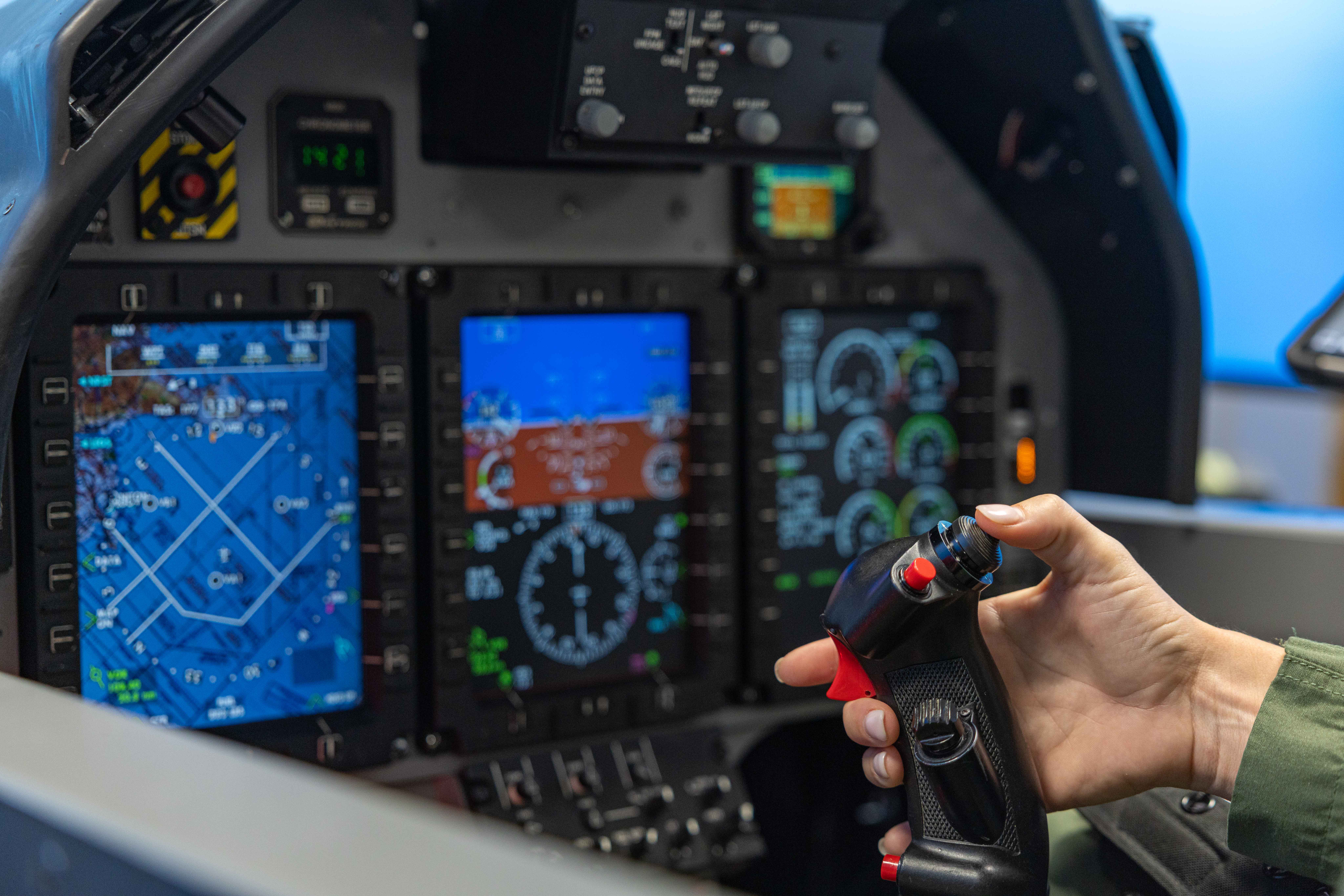
“When I started with Bulldogs, my first experience was with a cardboard cockpit,” says Air Commodore Rob. It may seem odd but having an accurate recreation of the cockpit for pilots to familiarise themselves with the layout of the cockpit, knowledge of the locations of toggles and switches, speeds up the initial phase of training.
“Operating within a battle space is so complex; with unmanned threats, enemy fighter jets, ground to air threats, your own friendly forces and maintaining comms channels means you don’t have time to think, oh, where’s that switch, again,” details the Air Commodore.
Committing such details to the “unconscious competence box, allows the pilots to be focusing on how best they can go about achieving their mission objective” and not having to dedicate valuable brain capacity to just operating the aircraft.
Armchair to Aircraft
It’s easy to assume that flying is like everything, the best thing you can do is just jump straight in but as the Air Commodore notes “it all starts with preparing your mind. We used to call it Armchair Flying, which we now call Mental Imagery & Visualisation.” This is the “Psychological Skills training programme delivered by Professor Dave Collins.”
“My first simulator didn’t have any visuals, it flew like a Hawk training aircraft, but there wasn’t a screen, so they painted the canopy white, to simulate being in a cloud.” Its relevance was not immediately apparent, however if you’re practicing instrument flying or emergency routines “it actually proved to be very useful,” says Air Commodore Rob.
Bring the Visuals
The next big step came in 1998-1999, with the introduction of the Hawk T1 simulator. It brought visuals, improvements to flying simulation and “Record and Replay, where an instructor could load in a perfect demonstration and then you could sit in the cockpit and you could watch what it looked like, with the stick movements and everything,” shares Air Commodore Rob.
However, it did have limitations, “with the graphics and the wider things you could do with it” and with the exponential increase in complexity with 4th and 5th generation aircraft and the battle space, the RAF training programme and its use of technology had to evolve to keep up.
Modern combat for pilots is more akin to “Enders Game than Top Gun, with pilots fighting the battlespace rather than a dog fight, and that’s true for a pilot of any aircraft or helicopter, not just a fast jet pilot. The only way we can properly prepare pilots to put them into a position to succeed is with brilliant simulation training” says Air Commodore Rob .
In 2023, the RAF made a huge investment into trying to simulate this environment.
Are You Not Entertained?
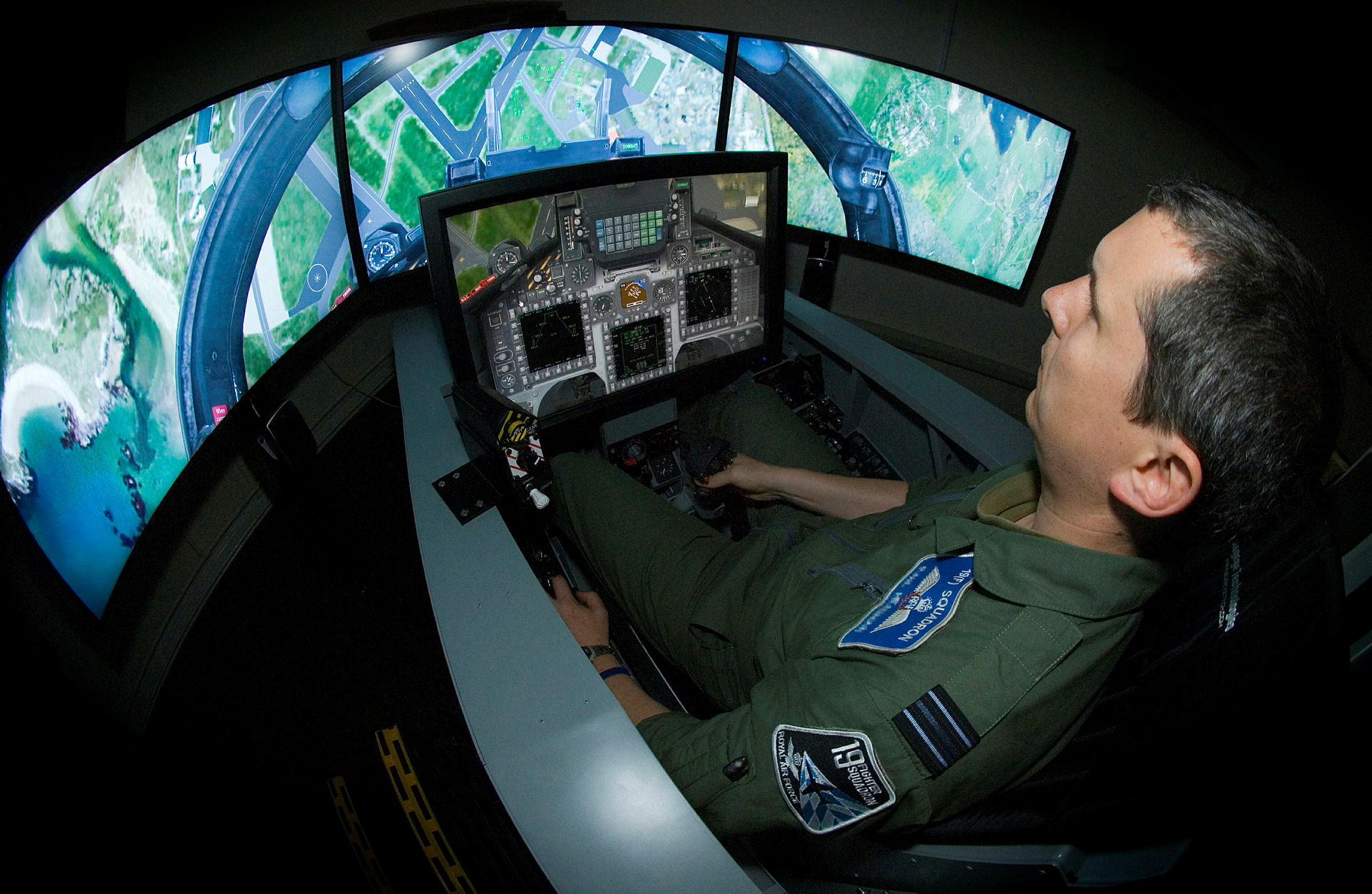
Based at RAF Waddington, the world-leading Gladiator system takes synthetic training even further. Unmatched anywhere in Europe, Gladiator connects simulators across Air, Land and Sea forces through a single central hub, enabling all three services to train together, share knowledge and sharpen their joint operational effectiveness.
It’s not just limited to UK borders.
Allies and partners from around the world can plug directly into Gladiator. In practice, this means RAF pilots can train alongside their counterparts from the French, German and United States Air Forces, practising dogfighting, formation flying and low-level navigation in a shared virtual environment.
This is introduced towards the end of the training pipeline, “for us to make sure our recruits can succeed, we need to build them up.”
Air Commodore Rob stresses that piloting in a complex environment is not a scenario where you drop someone into the deep end to see if they sink or swim.
Layering Complexities
“15 years ago, we implemented a layered approach to the training, which means each stage builds on the complexity of the previous step.”
How this translates to the use of technology within the training is that they start with “Computer aided instructions and briefs, which then builds into a desktop trainer level.”
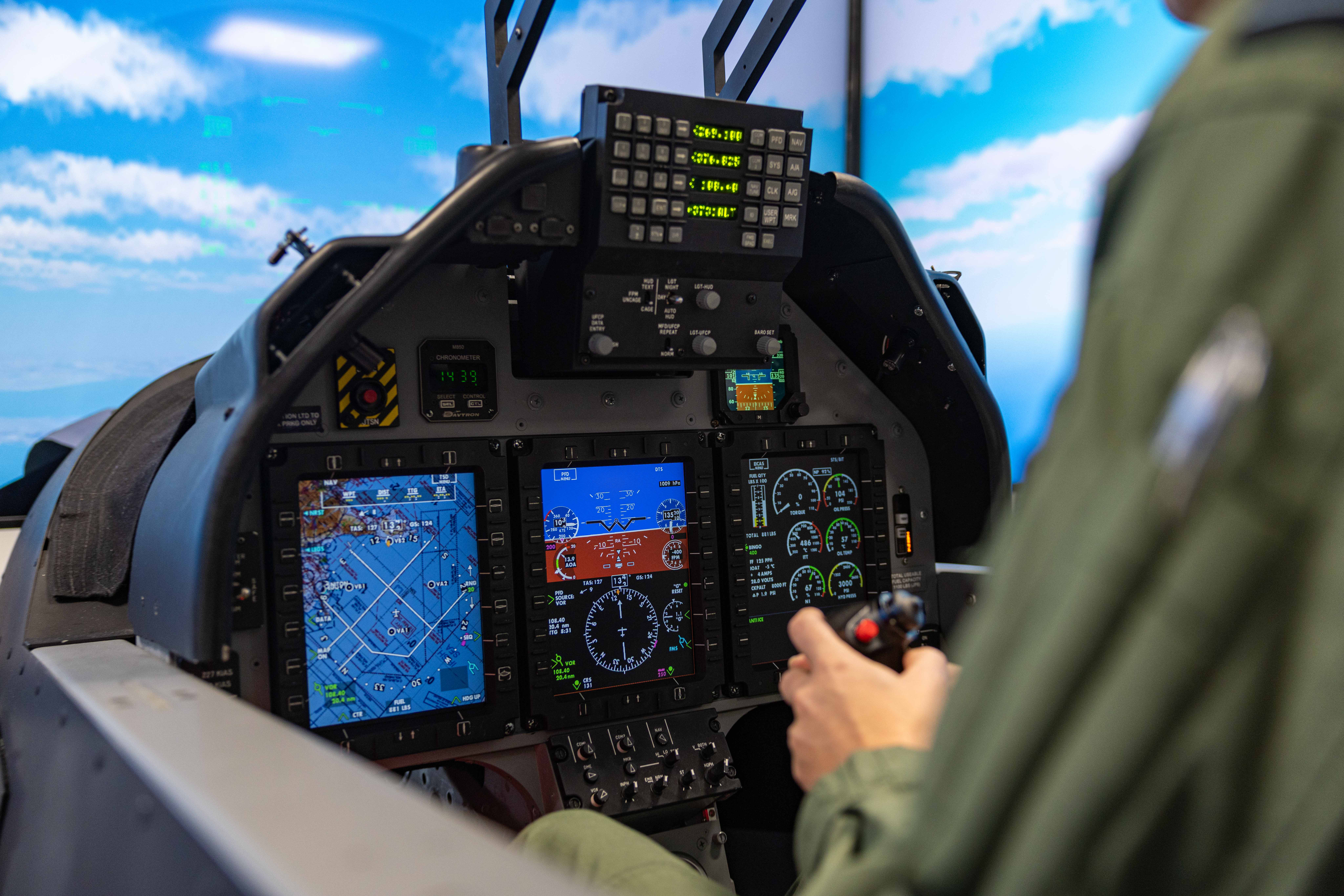
“Recruits are then given access to a Flying Training Device, which has the look and feel of a cockpit, but the pilot has TV screens in front of them to provide visuals.” Once this stage is completed, trainees will move on to a Full Mission Simulator, which looks, feels and flies like the aircraft.
Blurring the Line of Reality
This approach has proven highly effective in supporting trainee development, though Air Commodore Rob is keen to stress that "we have to be conscious of how we use the tools, and not let negative behavioural patterns develop."
As an example, the Air Commodore explains that if two pilots are practising in the sim and one manages to fly behind the other, "the lead pilot will just rotate their neck to track the other jet. This doesn't work in the real world, there's an ejector seat right behind you, so first you lean to one side and then rotate your neck to see round it."
A more practical limitation of the simulator is that, as the pilot tracks another jet, "when they turn around all they see is a projector." But as Air Commodore Rob points out, "this is where the exciting developments in virtual and mixed reality headsets come in."
Now, as the recruit tracks the jet behind them, they can see it through the virtual reality headset. Mixed reality takes this further still, pilots "can see through the headset and interact with aspects of the simulator in real time."
As with all technology, it’s always on the move. Air Commodore Rob highlights the development of augmented reality headsets: "This is really exciting stuff. Now pilots can do live flying with augmented airborne reality headsets on. Instructors can load an enemy jet of any kind into the programme, and it is projected into the pilot's headset, it will look and fly just like the real thing."
The benefits are significant: resource savings, more training missions per recruit, and a level of realism previously unattainable. "Normally for such missions you'd need two jets, two pilots and two instructors. Now all you need is one jet, one pilot and one instructor. Each recruit gets more sets and reps of flying training missions, and that's the greatest determining factor in a recruit succeeding."
Simulation Pays Off
However good the simulators are “in your heart and mind, you still know it’s not the real thing, but that’s where we see the greatest benefit of integrating the technology into live flying training.”
"The technology has already proved its value, with a significant reduction in the number of training sorties that must be flown again because the recruit hasn’t passed the objectives. This has meant more recruits are passing the course, proving how the technology is helping and illustrates how simulation is helping us get the most out of live flying hours.”
However impactful the technology is, “our instructors are everything, they are the people that make our pilots, we couldn’t do anything without our instructors. They knit the whole training programme together.”
As threats evolve and the pace of operations increases, synthetic training is no longer just a supplement to real-world flying, it is a cornerstone of how the RAF builds the force of tomorrow.
1 Miller , G.A. (1956a) ‘The Magical Number Seven, Plus or Minus Two: Some Limits on our Capacity for Processing Information’, Psychological Review, 63(10), pp. 81–97. doi:https://psychclassics.yorku.ca/Miller/#f1.