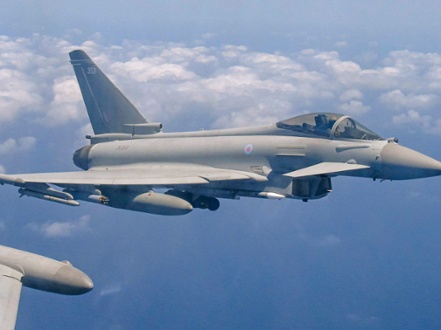
Often there is a comparison drawn between Formula 1 drivers and fast jet pilots, largely due to the speeds at which both operate.
However, as Air Commodore Rob points out, "the fast jet pilot represents a node in a network, while the F1 driver is part of a team, they are fundamentally involved in a solo endeavour."
What can be compared, however, is the cognitive and decision-making capability required at speed. Working alongside Sports UK, RAF instructors collaborated with their counterparts to explore how an elite psychology programme could be embedded into pilot training.
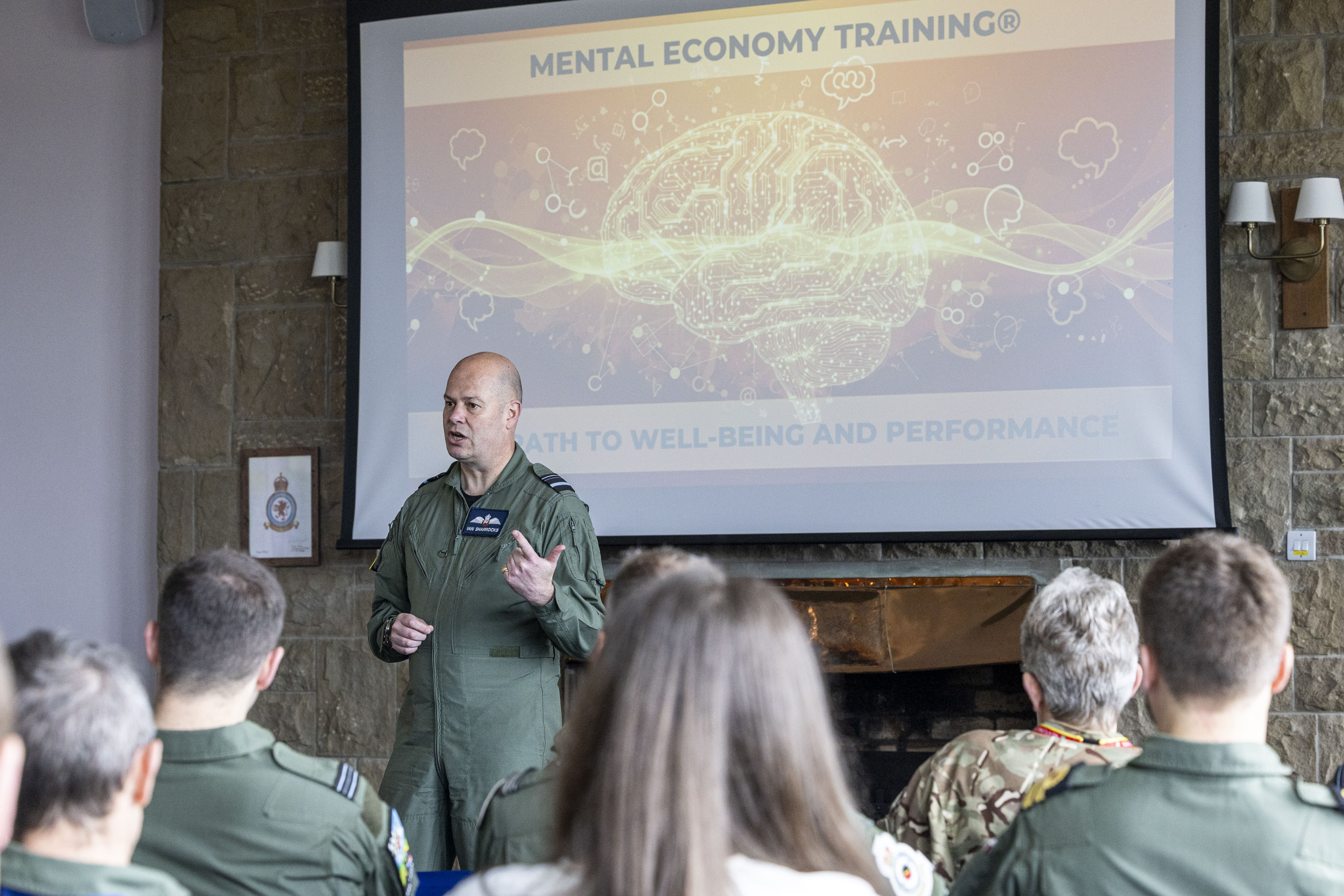
"We're very grateful for our time with Sports UK," says Air Commodore Rob. "As a result, we have developed a new training programme designed to improve decision-making at speed, which we call Elite Meta Cognitive decision-making skills."
The Moment Everything Changed
"Fifteen years ago, we started to really evaluate our training, we had to start taking some responsibility for the success of our recruits," says Air Commodore Rob.
For four decades, RAF instructors had been teaching pilot recruits to enter their "mission bubble," a mental state of complete focus, devoid of distraction, more widely understood as a flow state. Through training, recruits develop the ability to enter this state at will, and by the time they are flying on the front line, they will enter it up to eight hours before a mission begins.
The mission bubble offers many benefits, but Air Commodore Rob identifies the most significant: a reduced heart rate. Research into the relationship between heart rate and decision-making has found that above 145bpm, the ability to distinguish good decisions from poor ones becomes impaired.
As the battlespace grows increasingly complex and contested, "the ability to make good enough decisions at speed is often the differentiator." This is especially true of fourth and fifth generation fighters, which bring with them layers of interconnected systems and capabilities.
Playing Catch-Up
"It was time we started to take responsibility as teachers and instructors. We had to really start to consider how we could put our trainees in a position to succeed." Recruits were being asked to cope with massively complex tasks, but as Air Commodore Rob acknowledges, "our training process hadn't kept up with the rate of technological development."
It was this realisation, he says, that prompted the question: how do we build an elite psychology into our training culture? After time spent with the United States Air Force, who had introduced a cultural training programme called Human as a Weapon System, the RAF developed its own philosophy: the Combat Edge Programme.
The Pilot, Not the Plane
Combat Edge is a holistic approach to pilot development. "It is a cultural philosophy that, as instructors, we try to foster throughout the pilot programme. Essentially, it's all about the human, rather than the aircraft," explains Air Commodore Rob.
Without the pilot, he stresses, even the most advanced aircraft is simply a machine. "It only becomes the tip of the spear once there's a pilot behind the controls." The Combat Edge programme is therefore designed to maximise the pilot's capability, so they, in turn, can get the maximum from the aircraft. "If we can ensure our pilots are making good enough decisions, the likelihood of achieving mission objectives greatly increases."
Leading-Edge Training for a Changing Battlespace
The pace of technological development is exponential, and that, Air Commodore Rob says, is precisely why training had to evolve. "The demands on recruits had changed, and we hadn't yet. But now, we are operating at the very forefront of modern training techniques."
He is keen to recognise the people who make that possible. "I must thank my incredible team of instructors. It doesn't matter what training models, organisation charts or psychological theories you have, without exceptional people to deliver them, you don't have anything. We wouldn't be holding up our end of the deal if we didn't give our recruits the best instructors possible."